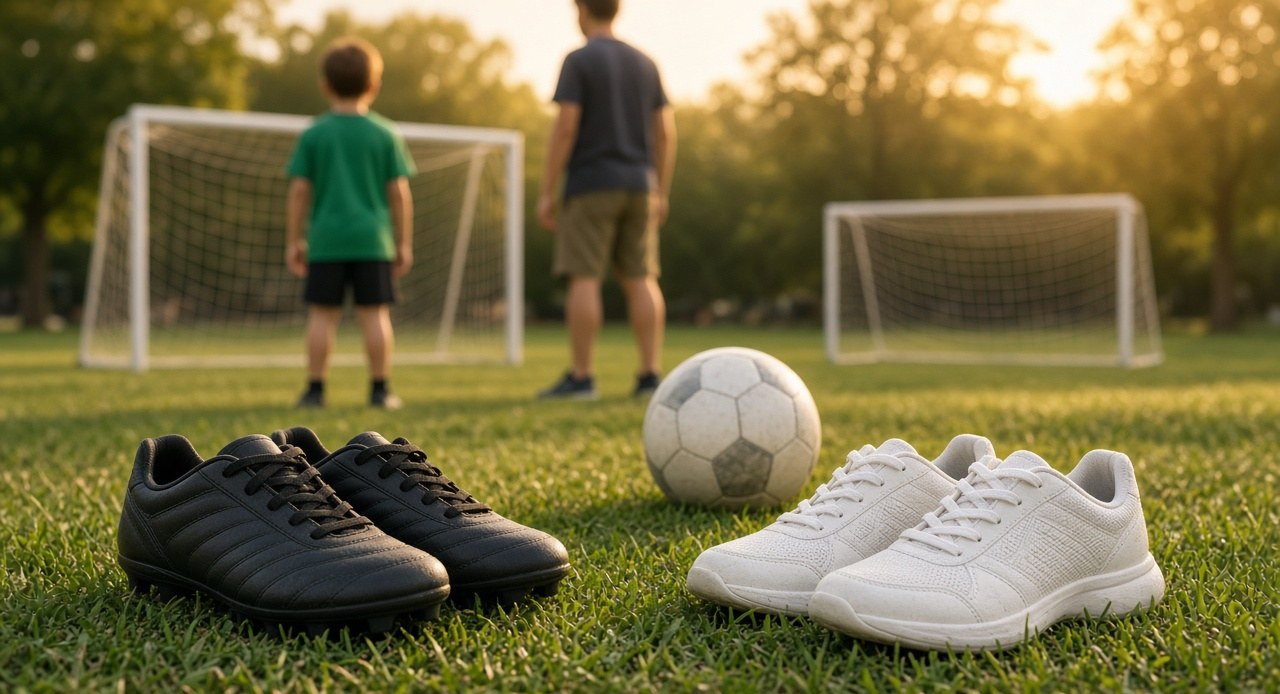
The cleat question shows up the week registration closes, not after a rules clinic. The confirmation email lists “shin guards and cleats.” A neighbor whose kid is in U12 travel swears sneakers are a slip hazard. Another parent in the U6 group chat says they wore running shoes all fall and nobody cared. Amazon then shows $80 junior Predators next to a $25 molded pair that looks like the same shoe.
This is a research-based parent guide to that split. It is not a backyard soccer goal buying guide, not a youth soccer ball size chart, and not a GPS vest article. Footwear is Law 4 compulsory equipment. Cleats are a type of footwear. The law does not say your six-year-old has to own a studded sole before the first Saturday.
It is also not a baseball-spike article. Metal baseball rules live on what age kids can wear metal cleats in Little League. Soccer uses a different book.
How we researched this guide
There is no NOCSAE stamp on a junior soccer shoe, and we are not going to invent a traction lab. This guide is built from:
- IFAB Law 4 — The Players’ Equipment, which lists footwear as compulsory and leaves the safety call to the referee
- AYSO’s published National Rules & Regulations language that athletic footwear with or without cleats is permissible if the referee approves it under Law 4
- AYSO’s national FAQs & Support pages on required kit, shoe inspections, toe cleats, and metal
- Local rec, club, and school pages that tighten those national sentences — no metal, no baseball toe stud, sneakers acceptable in U5–U8
- Manufacturer sole-type labels parents actually see on a box: FG, AG, TF / turf, IN / indoor
We are not publishing star ratings or a “tested on our U8 team” claim. A molded soccer shoe that is legal on grass can be the wrong shoe on a turf carpet, a gym floor, or a driveway backyard session.
The short answer
Most rec kids in U4–U8 do not need soccer cleats on day one. They need shoes that cover the whole foot, shin guards the socks actually cover, and a ball that matches their age. Buy molded soccer cleats when the kid is on real grass every week and sneakers start slipping. Buy turf shoes when the home field is short-pile synthetic. Do not buy baseball or football cleats “because we already have them in the bin.”
Work the decision in this order:
- Read this week’s league email, not a group-chat rumor. If the region says sneakers are fine, they are fine. If travel U11 says molded soccer cleats only, that is the rule for that roster.
- Look at the surface, not the birthday. Grass that holds a stud is a cleat field. A school turf carpet, a gym, or a dry infield skin is not.
- If you buy, buy a soccer sole. Molded plastic or rubber studs. No exposed metal unless this referee and this competition have already said metal is acceptable — and for youth rec, assume they have not.
- Fit the foot you have today. A half-size of “grow room” is how kids blister and roll ankles. Measure in the afternoon. Recheck in eight weeks.
- Keep the sneakers. You will still want them for the driveway, the gym night, and the Saturday the field is too hard for long studs.
Flag and rec house leagues that play 4v4 or 7v7 on a short field rarely punish a kid in running shoes. Spend the extra money on a size-right ball and shin guards the player will leave on.
What the law actually requires
IFAB Law 4
The Laws of the Game name five compulsory items: a shirt with sleeves, shorts, socks, shinguards, and footwear. Shinguards must be a suitable material, an appropriate size, and covered by the socks. Footwear is not described as “cleats,” “boots,” or “studs.” A player who accidentally loses a shoe must replace it as soon as possible; if they score before the ball goes out, the goal still counts. That sentence exists because shoes are required as shoes, not because a particular sole is required.
Law 4’s safety sentence sits above the shopping list: a player must not wear anything dangerous. The referee inspects players before kickoff. If the shoe is sharp, loose, or a baseball spike on a crowded U8 box, the referee can send the player to change it. Tape over a dangerous stud is not a workaround.
Jewelry is a separate, stricter sentence. Necklaces, earrings, and rubber bands come off. Covering them with tape is not allowed. That is why a parent who spent $70 on cleats and forgot the stud earrings still watches the first ten minutes from the bench.
AYSO national: sneakers are written in
AYSO is the rec program a lot of U5–U10 families meet first. The national rules do not say “cleats required.” They say athletic footwear, with or without cleats, is permissible in AYSO competitions subject to the referee’s safety call under Law 4. Shin guards that provide reasonable protection and sit completely under the socks are required for practice and matches.
The national equipment FAQ is even more parent-plain: shin guards are mandatory; full-coverage shoes are required; shoes designed for soccer are advisable, not compulsory. A later referee FAQ says soccer shoes from an established maker are acceptable, and other shoes are acceptable if the referee does not find them dangerous.
That is the legal floor. It is why a U6 in clean running shoes is usually allowed to play, and why a parent who delayed the cleat purchase until the kid asked for them is not breaking a national rule.
The metal and toe-cleat myth — and the local override
Two sentences get repeated in every registration packet, and both are half-true.
“Metal cleats are illegal in youth soccer.” AYSO’s national FAQ says the opposite of a blanket ban: metal (usually aluminum) is not automatically illegal, but the referee must inspect for burrs and sharp edges. Many local regions, clubs, and school leagues still write “no metal” into the house rules. Travel and rec on grass almost never need metal. Soft-ground screw-in metal is an adult wet-field tool. Do not buy it for a seven-year-old “to last.”
“Toe cleats are illegal.” The same AYSO FAQ says a blanket ban is too narrow. The myth started because parents showed up in baseball shoes, which often have a stud sitting on the tip of the toe. Some modern soccer soles wrap studs across the front in a way that is still a soccer pattern. The referee is looking for a dangerous point, not a vocabulary word. A baseball or football shoe with a distinct toe spike is the pair that gets sent back to the car in most U.S. youth games, because local packets do ban that pattern even when the national FAQ is more careful.
If your region’s PDF says “no metal, no toe cleat, sneakers OK in 6U,” that PDF wins on Saturday. National language is the floor. The sideline check is the ceiling.
Four shoes parents mix up
People reuse “cleats” until it means nothing. Name the sole before you pay.
1. Regular sneakers / running shoes. Flat or lightly lugged rubber. Legal under Law 4 and AYSO national if they cover the foot and the referee does not call them dangerous. Best first shoe for U4–U8 rec, gym nights, and hard summer fields. Worst shoe on wet grass once the kid is actually sprinting and cutting.
2. Molded soccer cleats (FG — firm ground). A plastic or TPU plate with a modest number of rounded or bladed studs. This is the default “first soccer shoe” for natural grass. Search youth soccer cleats and look at the sole photo: you want a soccer pattern, not a baseball toe spike.
3. Turf shoes (TF) and artificial-grass cleats (AG). Turf shoes use dozens of short rubber nubs. AG uses more, shorter, often rounded studs than a grass FG boot. These are the right tools for synthetic carpets, older school turf, and a lot of driveway or backyard work. FG blades on modern turf can stick when the kid plants and turns. That torque goes into ankles and knees.
4. Indoor / futsal shoes (IN). Flat gum rubber for gym floors and futsal courts. They are not outdoor shoes. They are also not “indoor soccer balls.” If the Tuesday session is in a cafeteria, these beat both cleats and running shoes.
A football or baseball cleat from last season is none of those four. It is a leftover with the wrong stud map. Recycle it or keep it for that other sport. Do not put it on a soccer field and hope the referee is busy.
Surface first, then age
Age is a hint. The field is the rule.
| What they play on most weeks | First shoe that makes sense | Skip |
|---|---|---|
| U4–U8 rec on short grass, school field, or dirt | Sneakers. Add cheap molded soccer cleats only if they slip | Premium FG, metal, baseball spikes |
| U8–U12 rec / rec-plus on real grass | Youth molded FG soccer cleats that fit today | Adult soft-ground metal, a size “to grow into” |
| Club or travel on grass and turf | Molded FG plus a turf or AG pair if the budget allows | One FG pair worn on every surface |
| Mostly 3G / 4G turf | AG or a hybrid FG/AG; turf shoes on short-pile carpets | Long FG blades as the only pair |
| Gym, cafeteria, futsal | Indoor shoes or clean court sneakers | Any studded sole |
| Driveway, garage, backyard rebounder | Turf shoes or sneakers | FG on concrete or asphalt |
A six-year-old on a dry September rec field and a ten-year-old on wet November club grass are not shopping the same shoe, even if both are “youth soccer.”
When sneakers are the smarter first buy
Sneakers win the first season when three things are true:
- The league email does not require cleats.
- The field is short, hard, or a school multi-use pitch.
- The kid may not stick with soccer past Halloween.
U4–U6 is a motor-skill class that happens to use a size 3 ball. Kids fall because they are six, not because the sole lacks a blade. A stiff new FG plate on a 4-year-old who still runs with a wide base is extra plastic to trip over. AYSO’s own parent FAQ calls soccer-specific shoes advisable. That word is doing work.
Sneakers also win mid-week when the “practice” is a home session on a patio, a basement, or dry packed dirt. Long studs on concrete chew the plate and turn an ankle. Keep the grass pair in the game bag.
What sneakers cannot do: hold a plant on wet grass once the player is actually changing direction at speed. If U9 rec is on a real pitch and the kid comes home with green knees every Saturday, that is the week to buy molded soccer shoes — not a reason to have bought them in May “just in case.”
When molded soccer cleats become the right pair
Buy the first soccer-specific pair when at least two of these are true:
- They play on natural grass most weeks, not a playground.
- Sneakers slip on the plant foot during cuts or shots.
- The coach or league now prefers or requires soccer shoes.
- The kid has asked to keep playing after the first season.
That first pair should be youth molded FG, not a clearance adult size 5 with metal threads. Youth lasts are narrower through the heel and shorter in the toe. An adult 5 on a U10 is a sail.
Look for:
- A soccer stud map (no isolated toe spike)
- A closure the kid can manage — traditional laces, or a kid-proof strap if they still cannot tie
- A sole that says FG or “firm ground,” not SG
- A price you will not resent when the foot jumps a size in March
Entry molded pairs from the big soccer brands and the youth-specific houses (the Adidas Goletto / predator-junior type, Nike Jr. Tiempo class, Vizari, Xara) are the listings parents actually finish. Start at youth molded soccer cleats and do a listing check: the sole photo should look like soccer. If you see a baseball toe stud, a metal wrench kit, or “football cleats” in the title, close the tab.
Do not chase the pro colorway. A $25–$45 molded junior shoe that fits will outlast a $90 replica that is a half-size long. The under-$100 youth gear page is the wider budget filter; this page stays on the sole.
Turf, driveway, and the second pair
A lot of U.S. youth soccer is no longer “grass on Saturday.” School 3G, park turf, and indoor winter leagues are normal. One FG pair used on all of that is how studs snap and how knees feel the field.
Turf shoes (TF) are the parent-friendly second pair. Short rubber nubs, sneaker-like cushioning, legal on most synthetic surfaces, and the pair you want for a backyard goal on a driveway or packed dirt. Search youth turf soccer shoes.
AG cleats sit between FG and TF. More, shorter, often hollow or rounded studs. If the club plays most matches on modern long-pile turf, AG is the match shoe and TF is the training shoe.
Indoor shoes are a third category, not a turf shoe with the nubs worn down. If Wednesday is a gym, buy youth indoor soccer shoes or use court sneakers. Cleats on a gym floor are a referee problem and a floor-manager problem.
If the budget is one pair, buy for the surface they play on most, not the surface you remember from high school. A turf-only club does not need FG. A grass-only rec team does not need AG. A U6 that practices on a blacktop and plays on short grass can live in sneakers until the grass Saturday starts to slip.
Sizing: the foot you have this month
Youth soccer shoes are sold in kids’ and junior sizes that do not map cleanly to the running-shoe size in the hall closet. Measure both feet in the afternoon. Fit the larger foot. Check three things in the shop or on the living-room rug if you are ordering online:
- Heel lock. The heel should not lift when they stand on their toes. Slip is a blister and a rolled ankle.
- Toe room. About a thumb’s width, not a full size. “Grow room” on a studded plate is how the foot slides into the toe on a plant.
- Width. Wide feet need a wide last (Tiempo-class and many Vizari / Xara youth shoes), not a speed boot copied from a pro catalog.
Have them wear the soccer sock they will play in, over the shin guard, when they try the shoe. A shoe that feels fine on a dress sock will feel small on Saturday.
Replace when the studs are rounded smooth, the plate cracked, or the toe is curled up from growth. Growth spurts mean many kids need a new pair every season. That is another reason not to buy the expensive pair a year early.
If you are between sizes, the manufacturer chart wins over “they’re a 3 in Nike running.” Brand lasts differ. Read the size chart on the listing you are actually buying.
What will get a kid pulled at check-in
Referees are not trying to ruin opening day. They are applying Law 4’s dangerous-equipment sentence in a U8 penalty area full of other people’s shins.
These are the pairs that get walked back to the parking lot:
- Baseball or softball cleats with a toe stud or metal spikes. Different sport, different rulebook. See the Little League metal-cleat guide if that is the actual question.
- Football cleats with a toe spike or a long, aggressive stud map.
- Screw-in metal SG boots bought because a high-school cousin wears them in November mud.
- Broken or missing studs, a separated sole, or a shoe that is two sizes long and slaps.
- Jewelry left on after you spent twenty minutes on the shoes. The earring is the thing they notice.
Shin guards worn over the sock, or cardboard “guards,” fail the other half of Law 4. The shoe can be perfect and the player still sits until the socks cover real guards. That kit is on the kids’ sports safety gear checklist page, not here.
Backyard and driveway: do not wear match FG on concrete
This site’s soccer traffic already lives on backyard goals, rebounders, and home programs. The shoe that belongs in that setup is almost never the match FG pair.
On a driveway or patio, long studs chatter, wear, and catch a crack. On a rebounder session, the player is hitting hundreds of plants in a small box. Turf shoes or sneakers keep the ankle over a stable rubber pattern. Save the grass pair for grass.
If the yard is actual lawn and they are shooting into a backyard goal, molded FG is fine — if the goal is anchored and the lawn is not a brick in August. Hard summer dirt behaves more like turf than like firm ground.
A GPS vest, a smart ball, or a kick trainer does not change the sole question. Those tools measure or multiply touches. They do not replace footwear, and they do not make FG safe on asphalt.
How to shop this week
- Open the league or region packet. Highlight the shoe sentence. If it says sneakers acceptable, believe it.
- Name the main surface for the next eight weeks: grass, turf, gym, or mixed.
- If it is U4–U8 rec on mixed or hard ground, stop. Use sneakers. Buy youth soccer shin guards if those are not already in the bag.
- If it is weekly grass and sneakers slip, search youth molded soccer cleats. Listing check: soccer sole photo, youth size, no toe spike, no metal kit.
- If it is mostly turf, search youth turf soccer shoes or AG, not a long FG blade.
- Measure both feet. Order the size that matches the chart for that brand. Do not size up for December.
- Try them on with game socks and shin guards. Walk, hop, plant. If the heel lifts, return them.
- Keep the sneakers in the bag. You will need them for the gym night and the driveway.
Prices move. Confirm the live listing, the size chart, and the return window before you click. This desk does not freeze a dollar figure on a junior Goletto.
Frequently asked questions
Does my 6-year-old need soccer cleats?
Need, as in Law 4? No. The law requires footwear, not cleats. Need, as in AYSO national? No — sneakers are written in if the referee calls them safe. Need, as in this Saturday on wet grass? Maybe, if they are slipping. Most U6 rec players can start in sneakers and add a cheap molded pair after the first month if the field asks for it.
Can kids wear running shoes to soccer?
Yes, in most rec and AYSO settings, as long as the shoe covers the foot and the referee does not call it dangerous. Shin guards under the socks are the piece that is actually mandatory. Running shoes are a poor idea on wet grass for older kids who are cutting at speed.
Are baseball cleats allowed in youth soccer?
Do not count on it. Baseball shoes often have a toe stud or metal spikes. Local youth-soccer packets commonly ban both even when AYSO’s national FAQ refuses a blanket toe-cleat or metal ban. Buy a soccer sole. Keep the baseball pair for baseball.
Are metal soccer cleats legal for kids?
AYSO national does not automatically outlaw metal; the referee inspects for sharp edges. Most local rec, club, and school rules still say no metal. Soft-ground metal is an adult wet-grass tool. It is the wrong first pair and the wrong ‘grow into’ pair.
What is the difference between FG, AG, and turf shoes?
FG is molded studs for natural grass. AG is shorter, more numerous studs for modern artificial grass. Turf (TF) shoes use small rubber nubs for short-pile synthetic, hard ground, and a lot of driveway work. Indoor shoes are flat gum rubber for gyms. Match the sole to the surface you play on most.
Should I buy soccer cleats a size big?
No. A half-size of grow room on a studded plate lets the foot slide on every plant. Measure this month, fit the larger foot, and plan to replace the pair when the foot grows — often every season. The expensive pair bought long does not become a bargain.
Do they need cleats for backyard practice?
Usually no. Driveway and patio sessions want turf shoes or sneakers. Wear match FG on grass in the yard if the lawn is actually grass and the goal is anchored. Do not put long studs on concrete.
A decision you can finish this week
Put the packet first. If this region already says sneakers are fine, you are not behind the U12 travel parent in the parking lot. If this roster already says molded soccer cleats only, you are shopping a youth soccer sole that fits today, not a baseball leftover and not a metal boot.
Skip the toe-spike “cleats we already own.” Skip the size-up for spring. Skip the $90 colorway for a kid who still might quit after Halloween. Send that money to shin guards, a correct-size ball, and the home training setup they will actually use between practices.
The youth soccer shoe question is not “do academy players wear Predators on TV?” It is “does this field, this weekend, need a stud — and if it does, is the stud a soccer stud?” Answer those two, and the cart is obvious.
How we evaluate: We combine manufacturer documentation, independent user feedback, and parent-focused criteria like safety, durability, ease of use, and long-term value.
Accuracy note: Pricing and product availability can change. Verify details on the retailer site before purchase.
Affiliate Disclosure: Sports Gadget Review is a participant in the Amazon Services LLC Associates Program. When you purchase through links on this page, we may earn a commission at no extra cost to you. Editorial recommendations are made independently.