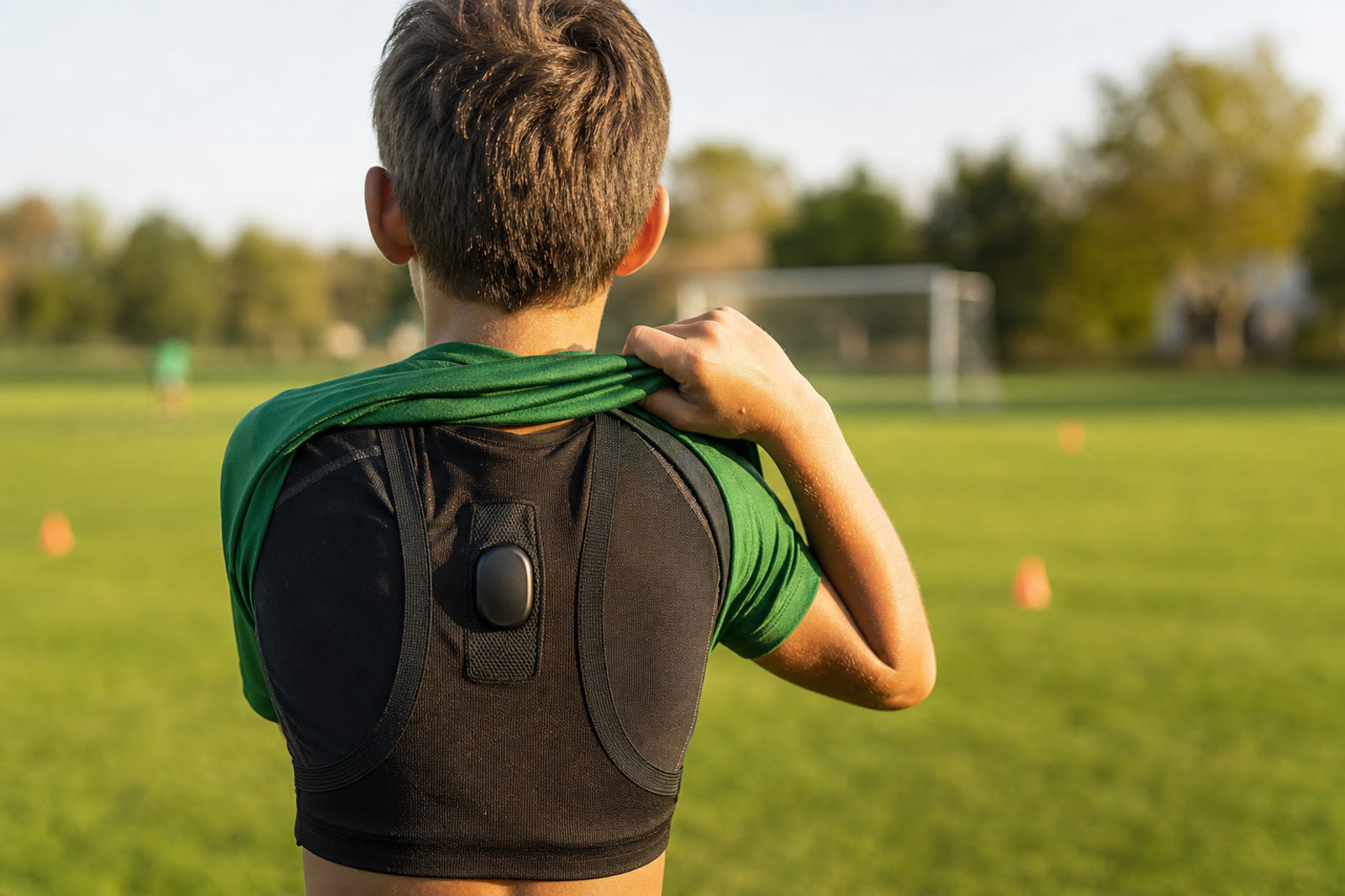
The GPS-vest question usually arrives after a tournament weekend, not after a rules clinic. Your junior player’s club issued a tight black bib with a hockey-puck pod between the shoulder blades. Another parent on the sideline swears every serious U12 needs one at home. Amazon then shows a $29 “soccer GPS vest” that is obviously a phone pocket. You now have three catalogs open: a club-issued Electronic Performance and Tracking System (EPTS) unit you do not own, a consumer kit with youth chest sizes, and a budget listing that uses the same words.
This is a research-based parent guide to that three-way choice. It is not a smart soccer ball review, not a backyard soccer goal buying guide, and not a GPS running-watch roundup for cross-country or track. A soccer GPS vest is a soft harness plus a satellite pod worn on the upper back. It measures how a field player moves across grass. It does not teach a first touch, and it does not replace shin guards.
If the actual question is a lace-mounted foot sensor or a sensor inside a shin guard, those are different products. See smart shin guards for youth soccer and the broader smart soccer training tech page. Multi-sport wearables that happen to mention a vest live on smart fitness watches for team sports. This page stays on the junior soccer vest.
How we researched this guide
There is no “youth GPS vest” stamp the way there is a NOCSAE helmet stamp, and we are not going to invent a lab. This guide is built from:
- IFAB Law 4 on compulsory equipment, jewellery, and electronic performance and tracking systems (EPTS)
- FIFA’s public Quality Programme for EPTS, which is the safety-and-accuracy language competition organisers are told to use
- US Youth Soccer’s STATSports partnership for National League Elite 64, which is how many U.S. parents first see a vest on a 13U–19U roster
- Manufacturer sizing and kit contents for the main parent-buyable vest system, the STATSports Apex Athlete Series (pod + Apex 2.0 vest + app; youth chest sizes published on the product pages)
- Owner and retailer themes for Catapult One individual kits: a FIFA-labelled 10 Hz pod in a harness, plus a membership that can brick a used unit if the subscription is gone
- Amazon listing patterns for “soccer GPS vest” and “junior GPS tracker,” which mix real pods, replacement bibs, and phone-holder compression shirts
We are not publishing star ratings or a “tested on our travel team” claim. A vest that fits a 29-inch chest and talks to this year’s app can be a paperweight on a 24-inch chest or last year’s orphan pod.
The short answer
Most rec and first-year travel juniors do not need a parent-bought GPS vest. If the club already issues a pod for matches, do not buy a second ecosystem. If you are buying, buy a named GPS pod plus a sized vest, not a $30 shirt with a phone sleeve.
Work the decision in this order:
- Ask the club what they already issue. If every starter wears a STATSports or Catapult bib on Saturday, you may already have the hardware. Ask whether a parent can rent, borrow, or buy into that system.
- If the club issues nothing, decide whether you want match-legal field GPS (vest + pod) or training-only wrist GPS. A hard watch is a different, often illegal, tool on a referee’s pre-game check. That watch question belongs on the youth cross-country and track GPS page, not here.
- If you buy a vest kit, measure chest circumference and pick the manufacturer’s youth size, not “small adult.” Tight is the point. A loose bib lets the pod bounce and the GPS track wander.
- Skip the budget phone-pocket vest. A smartphone in a back pocket is not an EPTS device. It is a hard rectangle on the spine. Referees can send the player off to remove it.
Flag and rec house leagues that still play 7v7 on a short field rarely generate GPS numbers a parent can act on. Spend that money on a ball, a rebounder, and shin guards the kid will actually wear.
What a soccer GPS vest actually is
A soccer GPS vest is two parts that get sold as one phrase.
The pod is the tracker. Consumer and club units used in soccer are typically a 10 Hz GNSS unit with an inertial sensor, charged by a clip or cable, and paired to a phone app over Bluetooth. Manufacturer pages for STATSports Apex and Catapult One both lean on the same selling points: total distance, high-speed or sprint distance, maximum speed, accelerations, and a pitch heatmap. FIFA’s EPTS programme exists because those numbers are easy to market and easy to get wrong.
The vest is a tight compression harness with a pocket between the shoulder blades. The pocket is the whole product. A high back pocket keeps a clear view of the sky and keeps a hard pod off the kidneys and off the ball. STATSports describes the current Apex 2.0 vest as a bonded, heat-sealed outer mesh pocket on a tight elastane body. Catapult’s consumer kit likewise ships a dedicated vest, not “any shirt you already own.”
If a listing shows only a vest and no pod, you are looking at a replacement bib. That is useful if you already own a matching pod. It is useless as a first purchase.
If a listing shows a vest and a phone, you are looking at a phone holster. That is not a junior GPS tracker. Treat it as apparel.
Four products parents mix up
People reuse “GPS vest,” “GPS tracker,” and “soccer tracker” until they mean nothing. Before you pay, name the form factor.
1. Club EPTS vest (issued hardware). A team-owned pod in a club bib, often STATSports Apex Coach / Academy or a Catapult team system. The coach dashboard is the product. US Youth Soccer’s Elite 64 partnership with STATSports is the public example: the organisation, not the parent, put FIFA-approved pods on 13U-and-up National League players. You do not need to Amazon a second kit to “keep up” if the club already logs Saturday.
2. Consumer GPS vest kit. A parent-bought pod + vest + app. The STATSports Apex Athlete Series is the kit that still shows up as a complete box for families: GPS performance tracker, Apex 2.0 vest, protective case / charging cable, and app access. Youth chest sizes are written on the product pages (Youth Small 25–27 inches / about ages 6–7, up through Youth XL 31–33 inches / about ages 12–13). Adult sizes start around a 36-inch chest. That size split is the junior angle. An adult small on a U10 is a sail.
3. Phone-pocket “GPS vest.” Compression shirts and running vests with a zip pocket marketed as GPS because you can drop a phone in them. They track whatever the phone tracks, if the phone stays put, if the battery lasts, and if the referee does not notice a glass slab on the player’s back. This is the budget listing that pollutes “soccer gps vest” search results.
4. Not-a-vest trackers. A GPS watch is a wrist computer for continuous running. A smart shin guard hides a pod on the calf. A lace sensor (PlayerMaker and similar) sits on the boot. Those can be the right buy for a different question. They are the wrong cart if you specifically need a match-worn back pod that a coach already knows how to read.
A padded football rib vest is also not this product. If that is the actual question, it lives on the youth quarterback rib-protector guide.
Junior sizing is a chest measurement, not an age
STATSports publishes youth chest sizes on the Athlete Series pages. The ages next to those sizes are a hint, not a birthday rule:
| Vest label | Chest (in) | Manufacturer age hint |
|---|---|---|
| Youth XS | about 23–24 | smaller than Youth Small |
| Youth Small | 25–27 | 6/7 |
| Youth Medium | 27–29 | 8/9 |
| Youth Large | 29–31 | 10/11 |
| Youth XL | 31–33 | 12/13 |
| Adult Small | 36–38 | teen / adult |
Manufacturer copy tells you to buy the smaller size if you are between measurements. That is the opposite of how parents buy rec jerseys. A GPS vest that rides up dumps the pod onto the lower back. A GPS vest that hangs like a pennant lets the pod flop on every cut. Measure over a thin t-shirt, tape level across the fullest part of the chest, and write the number down before you open Amazon.
A 10-year-old with a 30-inch chest is a Youth Large, not “the adult kit on sale.” A 13-year-old with a 35-inch chest may have outgrown youth XL and still be too small for adult small. That in-between kid is why club-issued bibs in two sizes sit in the team bag. If you are between youth XL and adult small, ask the club what they issue to the same body before you guess.
Girls and boys use the same chest chart on the current Apex vest pages. The vest is unisex compression fabric. Fit is still the test: arms up, jump, twist. If the pocket walks, the size is wrong.
Are GPS vests legal in junior matches?
Often yes as optional EPTS, if the vest is soft, the pod is covered, and the competition has not banned wearables. That sentence has three traps.
IFAB Law 4 lists the compulsory kit: shirt, shorts, socks, shinguards, footwear. A GPS vest is other equipment. Players may not wear electronic or communication gear except where EPTS is allowed. For official competitions under FIFA, a confederation, or a national association, the organiser is told to make sure wearable EPTS is not dangerous and meets the FIFA Quality Programme for EPTS.
That is permission with homework, not a parent coupon. Rec and travel events in the United States usually play under US Soccer / US Youth Soccer / state-association modifications of those Laws. The referee can still decide a specific unit is dangerous — hard edges, a loose strap, a pod that has come out of the pocket — and send the player off to fix it. USSF’s long-standing equipment guidance to referees is the same idea: inspect the actual item, focus on sharp or hard characteristics, and remember the referee is the last word.
Practical parent translation:
- A soft vest with a covered pod is the form factor referees already see on academy and Elite 64 sidelines.
- A wristwatch is the form factor that gets pulled as jewellery or hard equipment. Do not buy a GPS vest problem and then solve it with a running watch on game day.
- A phone in a back pocket is the form factor that looks like a brick. Do not spend “budget vest” money to create an equipment violation.
- Live data on the sideline is a separate IFAB conversation. Law 4 puts reliability rules on the organiser when EPTS feeds the technical area. Your U11 coach glancing at a parent phone is not “official live EPTS.” Do not pick a fight with the referee over a heatmap at halftime.
Ask the club and the weekend’s rules PDF two questions: (1) are wearable EPTS pods allowed in this division, and (2) does the event require a FIFA Quality mark on the unit? Get the answer in writing if you can. Tournament weekends sometimes use different kit rules than Tuesday night league.
Club-issued tracker vs parent-bought vest
This is the junior-specific fork Amazon cannot see.
If the club issues pods, the parent job is laundry and charging, not shopping. Mixing a STATSports Athlete Series account with a Catapult team dashboard because a listing was $40 cheaper is how you get two apps, no coach view, and a kid wearing two bibs. Ask whether the club sells or rents extra vests in youth sizes. A replacement vest for the club’s pod is the honest budget buy.
If the club issues nothing, a consumer kit is a family science project. The STATSports Athlete Series app is built for the player and parent: sessions, heatmaps, personal bests, friend leaderboards, a “Pro Score” comparison marketing line. That is motivating for some U12s and noise for others. It is not the same as a coach seeing the whole roster on one screen. US Youth Soccer’s Elite 64 write-up is honest about the club-scale version: data shared toward colleges and federations is an organisation programme, not something a $200 Amazon box unlocks for a rec U10.
If the club is “thinking about GPS next year,” wait. Orphan consumer pods are a known used-market problem in this category. Catapult’s individual One product has been sold as a pod plus a membership. Owner reports and Catapult notes in that channel say an individual unit does not move cleanly to a new user when the subscription is the activation key. A used “FIFA-approved GPS pod, no vest, no account” listing is a paperweight risk. Budget is not free if the app is dead.
The budget vest trap (listing check)
Search “soccer gps vest” and you will see three families of listings. Do a listing check before the cart.
A. Complete consumer kit. Title or bullets name a GPS performance tracker / pod, a vest size, an app, and usually 10 Hz or a FIFA Quality / FIFA-approved line. Box contents should include the pod, vest, charger, and case. Youth chest inches should be on the page. This is the only family that answers “junior GPS tracker for soccer” as a parent purchase.
B. Vest only. Title says Apex vest, GPS bib, or replacement harness. Fine if you already own the matching pod. Not a tracker.
C. Phone holster. Photos show a smartphone, a rear zip, or the words “phone holder,” “running vest,” or “for Apple Watch.” Distance will be whatever the phone’s GNSS does in a bouncing pocket. That is not match EPTS, and it is a bad spine accessory for a tackle or a goalkeeper collision.
Other listing-check tells:
- One size / “fits kids and adults.” Real youth kits publish a chest chart. A unisex free-size bib is apparel.
- No Hz, no pod weight, no app name. Marketing is using “GPS” as a synonym for “sporty.”
- Shin-guard photos in a vest listing. That seller is mixing this page with smart shin guards.
- Hard plastic chest plate. Wrong sport. You want fabric and a covered puck, not football hardware.
Shop the real kit with a search, then read the size on the variation dropdown: STATSports Apex Athlete Series GPS. If you only need a second bib for a pod you already have, search STATSports Apex vest and confirm it is the 2.0 pocket style that matches your pod. The noisy category search is soccer GPS vest — use it to compare, then apply the listing check above. Used or membership-tied units should be treated as Catapult ONE GPS homework, not a bargain.
Amazon prices and size availability move. Treat every link as a current-listing check, not a locked SKU.
When a junior GPS vest is worth the money
Buy — or lobby the club to buy — when most of these are true:
- The player is U11 / 9v9 or older on a full or nearly full pitch. GPS distance on a 7v7 postage stamp is mostly standing and five-yard bursts.
- They train three or more sessions a week plus a match, so week-to-week load is a real number, not one Saturday.
- A coach, athletic trainer, or parent will open the app the same week. Unread heatmaps are a $200 laundry problem.
- You care about sprint volume and high-speed distance, not a single “max speed” screenshot for group chat.
- The vest will be worn in games the referee will allow, or you accept it as a training-only tool.
Return-from-time-off is the one medical-adjacent use that is easy to oversell. A vest can show that this week’s high-speed distance jumped versus last month. It cannot clear a kid to play. That is a clinician and a return-to-play protocol, not a pod. If the worry is head impact, that is a concussion-protocol conversation, not a GPS vest.
When to skip and spend elsewhere
Skip the vest when:
- The league is rec, the kid is new to travel, or they already hate tight undershirts. Adoption kills more youth gadgets than accuracy does.
- The club will issue pods in the next season. Wait and buy the matching extra vest if you need one.
- The actual goal is first touch, weaker foot, or shooting. A home training kit and a backyard goal change those skills. A heatmap does not.
- You wanted a location-safety watch for walking to school. That is a kids’ LTE watch, not a 10 Hz EPTS pod. Different aisle.
- You wanted heart-rate zones. A vest kit may offer an add-on strap; the parent HR roundup is heart rate monitors for youth athletes. Do not assume the vest pod is a chest strap.
What the metrics mean on a junior pitch
Club marketing compares kids to professionals. That is entertainment. For a junior, use a short list.
Total distance is the session size. It goes up with pitch size, minutes, and how much the coach has them standing in lines. A U10 rec game and a U14 11v11 are not comparable. Log the same type of session if you want a trend.
High-speed or sprint distance is the number that actually describes soccer. Walking the wing between actions inflates total distance. Repeated 20-yard efforts show up here. Week-to-week spikes in high-speed work are the load conversation coaches already have without a pod — the vest just writes it down.
Maximum speed is the screenshot parents send. It is sensitive to GPS bounce, a downhill touchline, and a single lucky fly-out. Do not rebuild a training week around one peak.
Accelerations and decelerations are why a vest sits on the back instead of a running watch. Field soccer is cut, stop, and go. Wrist GPS built for a 5K under-counts that. This is the legitimate reason a junior soccer player might want a vest instead of the XC watch already reviewed on this site.
Heatmaps are a teaching picture, not a scouting report. A U12 center mid who never enters either box is a coaching cue. A U9 heatmap on a tiny field is a blob.
Pro comparisons and leaderboards are optional motivation. They are not a recruiting file. Elite 64’s STATSports write-up is about a sanctioned league programme. Your driveway session is not that programme.
If you want skill data — touches, strike, spin — you want a ball or a boot sensor, not a back pod. That split is why this article does not retitle or replace the smart sports balls page.
Heat, laundry, battery, and the “two-vest” trick
Youth soccer in August is already a heat sport. A compression vest under a jersey is an extra layer. If the club also issues a padded goalkeeper shirt or the player wears a thick winter base layer, try the stack at one practice before a medal-round Saturday.
Manufacturer consumer kits advertise multi-session batteries in the six-hour range. That is enough for a tournament day if you start charged. It is not enough if the pod sat in a backpack for three weeks. Charge on a Friday habit, the same way you charge a phone.
Wash the vest, not the pod. Heat-sealed pockets fail when someone tumbles the bib with a puck still in it. Hang dry. Buy a second vest if siblings share a pod — that is the cheapest “budget” move that still uses a real tracker. Search STATSports Apex vest and match the pocket generation.
Water resistance on these pods is “rain and sweat,” not “left in a water bottle.” If the listing does not say the pod comes out before washing, assume it does.
How to shop this week
- Email the coach or DOC: do we issue GPS? which brand? can parents buy a matching youth vest?
- If yes, buy only the matching vest size. Stop.
- If no, measure chest and decide whether you will actually open an app.
- If yes, shop a STATSports Apex Athlete Series listing that names pod + vest + app and the youth chest size you measured. Prefer the official size chart over “age 10.”
- Do a listing check. If the photo is a phone, walk away. If the title is vest-only, walk away unless you already own the pod.
- Ask the next referee-facing adult whether EPTS vests are allowed in this division. Soft covered pod is the usual yes. Phone holster is the usual no.
- Wear it for a midweek session. If the kid spends the hour pulling at the neckline, return it. Unused GPS is just compression laundry.
Frequently asked questions
Does my junior soccer player need a GPS vest?
Need, as in required kit? No. Law 4 compulsory equipment is shirt, shorts, socks, shinguards, and footwear. Need, as in useful? Sometimes, for U11+ players on a real pitch whose coach or parent will read high-speed distance. Rec and first-year travel usually get more from a ball and a rebounder.
Is a $30 soccer GPS vest on Amazon good enough?
Usually it is a phone pocket or an empty bib. A budget vest is only a bargain if you already own the matching GPS pod. If the listing does not include a named tracker, an app, and a youth chest size, it is not a junior GPS tracker.
STATSports vs Catapult for a parent purchase?
For a family buying one kit off the shelf, STATSports Apex Athlete Series is the consumer box that still publishes youth chest sizes and app access without a club contract. Catapult One individual kits have been sold with a membership that can strand a used pod. If the club already runs Catapult, buy into that system instead of mixing brands.
Can they wear a GPS watch instead of a vest?
For a run on the roads, yes — that is a different article. For a sanctioned soccer match, a hard watch is the piece referees already pull. A soft vest with a covered EPTS pod is the form factor the Laws discuss. Do not treat a cross-country watch as a match-legal soccer tracker.
What size GPS vest for a 10-year-old?
Measure the chest. STATSports youth large is 29–31 inches with a 10/11 age hint. Plenty of 10-year-olds are a youth medium or a youth XL. Age is a hint. The tape is the rule. If you are between sizes, the manufacturer says go smaller.
Are GPS vests safe?
FIFA’s EPTS programme exists to test that wearable trackers are not dangerous in contact. A covered pod in a tight pocket is the intended use. A loose hard pod, a phone on the spine, or a vest with sharp hardware is the referee’s safety problem. The vest does not prevent ACL tears or concussions.
Will a GPS vest get my kid recruited?
No. A sanctioned league programme can share performance data. A parent app screenshot cannot. Film, minutes, and the coach still do that job. Use the vest to manage load and show the player what ‘working’ looks like on a pitch.
A decision you can finish this week
Put the club question first. If they already hand out pods, you are shopping a youth vest in that brand, not a new tracker. If they hand out nothing, measure the chest, decide whether anyone will read sprint distance, and only then open a STATSports Apex Athlete Series listing that includes the pod.
Skip the phone-pocket bib. Skip the used membership pod you cannot activate. Skip the vest entirely if the kid still plays rec on a short field — send that budget to home training equipment instead.
The junior soccer GPS-vest question is not “do academy players wear a puck on TV?” It is “does this club already log this pitch, and if not, will a sized consumer pod get opened after practice?” Answer those two, and the cart is obvious.
How we evaluate: We combine manufacturer documentation, independent user feedback, and parent-focused criteria like safety, durability, ease of use, and long-term value.
Accuracy note: Pricing and product availability can change. Verify details on the retailer site before purchase.
Affiliate Disclosure: Sports Gadget Review is a participant in the Amazon Services LLC Associates Program. When you purchase through links on this page, we may earn a commission at no extra cost to you. Editorial recommendations are made independently.