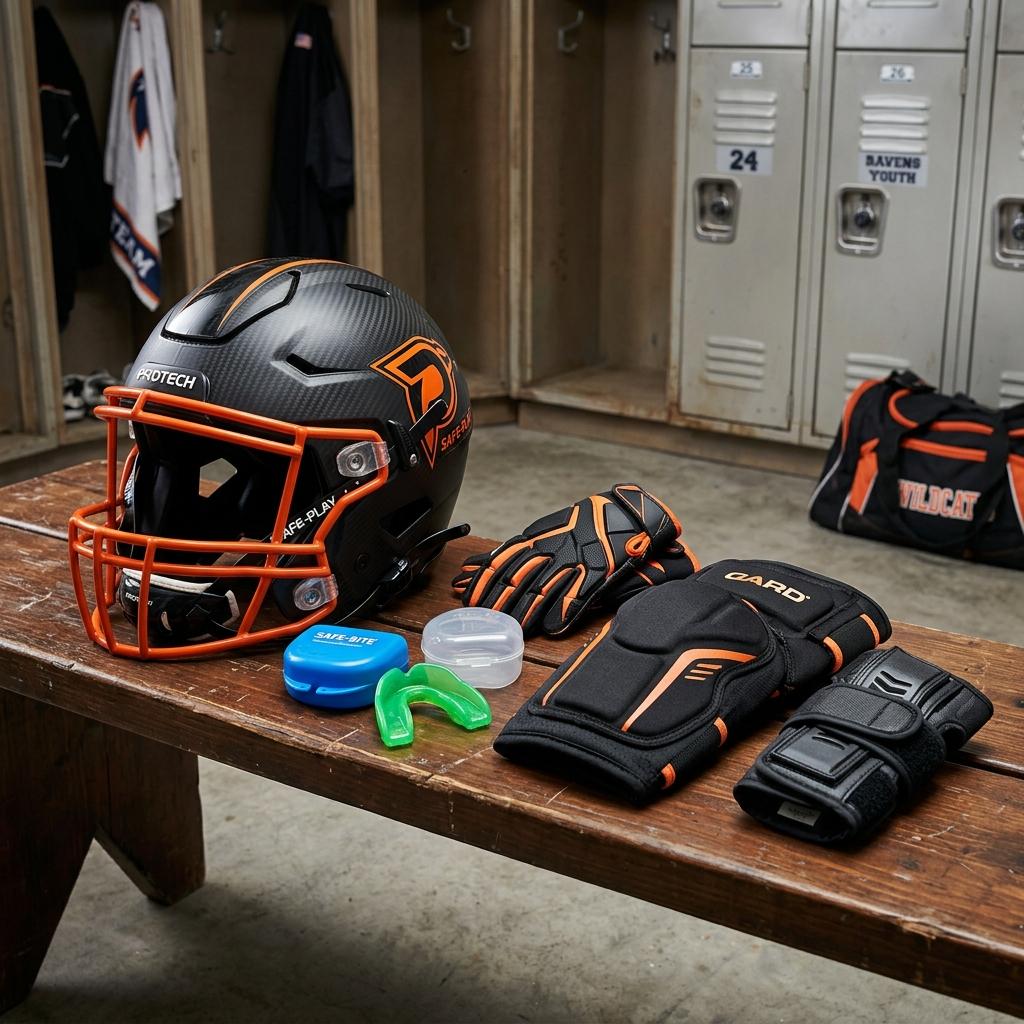
The top safety gear for kids’ sports is the gear the current rulebook requires for that sport and position, fitted to the child now—not equipment bought to grow into. Start with the Required column below, confirm the current season’s local league rules, then add recommended eye, dental, and impact protection for the risks the child actually faces.
| Sport | Required baseline from a named rule source | Recommended additions |
|---|---|---|
| Football | Helmet and shoulder pads, plus the mouthguard and lower-body pads in the local rulebook; use USA Football’s parent equipment questions to audit league-issued gear | Properly fitted athletic cup; padded compression layer if the league allows it |
| Soccer | Shin guards covered by socks and footwear under IFAB Law 4 | ASTM F803 sports eyewear; mouthguard where the dentist or league recommends one |
| Baseball / softball | NOCSAE batting helmet; catchers need helmet/face mask with throat guard, chest protector, and shin guards under the Little League Safety Code | Position-appropriate cup or pelvic protector; legal face guard or fielding mask |
| Ice hockey | Helmet/face protection, mouthguard, neck-laceration protector, and player- or goalie-specific pads under USA Hockey Rule 304 | Cut-resistant base layer; spare mouthguard |
| Lacrosse | Boys’ and girls’ field-player and goalie requirements differ; use the current USA Lacrosse equipment guide | Rib pads for boys where optional; extra eye protection only if legal for that ruleset |
These are national-rule baselines, not a substitute for the registration packet. School, club, state, age-group, position, and tournament rules can add or change requirements, so ask the league what it supplies and what it will inspect before buying.
Sports that are not in the table still start with that packet. Basketball and volleyball rarely require a helmet; wrestling ear guards are a common written requirement; bike and BMX work belongs on a CPSC bicycle helmet, not a team-sport shell. If the coach cannot name the standard they will inspect, wait before you click.
Skip-buy: wrong-sport and grow-into gear
Skip first a helmet, guard, or pad bought because the Amazon title says “youth sports safety.” The listing check is the sport name plus the standard the league actually uses.
- Skip a helmet from another sport. A CPSC bike helmet is not a NOCSAE batting helmet. A football helmet is not a boys’ lacrosse helmet. HECC hockey certification is not interchangeable with football NOCSAE. If the shell does not name the sport and the mark the inspector looks for, it is the wrong listing.
- Skip grow-into sizes. Extra shell volume that “leaves room for next year” lets the helmet slide. Fit the head you have this season; see the helmet check below.
- Skip used helmets and pads when nobody can show inspection or reconditioning history. League-issued used gear is a different case only when the program documents that history.
- Skip soccer shin guards for baseball, and baseball cups as “required” soccer kit. Required columns above are sport-specific. A bin leftover from last season is not a rulebook.
- Skip extra electronics first. Impact sensors and heart-rate straps are optional monitors, not required protective equipment and not a diagnosis. Sensor shopping stays on the parent guide to concussion sensors; youth football STAR / NOCSAE comparisons stay on youth football helmet safety ratings.
This page is the live keeper for the old /blog/youth-sports-safety-gear/ URL. That alias still 301s here — do not shop a second “youth safety gear” article.
Parent Buying Priorities
- Buy required gear first. Use the current rulebook, not an old team email or a retailer’s “required” label.
- Fit the child today. A larger helmet, guard, or cup bought for future growth can shift away from the area it is meant to cover.
- Match the standard to the sport. NOCSAE, ASTM, HECC, and SEI markings apply to particular products and sports; a generic “safety certified” claim is not enough.
- Inspect before every use. Check shells, foam, straps, fasteners, lenses, and fit.
- Add optional gear by exposure. Position, ball speed, contact rules, prior dental work, and vision needs matter more than a universal extras list.
Protective equipment can reduce specific hazards, but it cannot make a sport injury-proof. Impact sensors and other electronics are optional monitoring tools, not required protective gear and not medical devices for diagnosing a concussion. Desk research only: named rulebooks, manufacturer fit notes, and the certification marks those bodies publish — not a lab test this desk ran, and not invented injury rates.
Mouthguard Tiers: Fit Before Price
The American Dental Association’s mouthguard guide separates guards into three useful buying tiers:
- Stock ($2–$15): ready-made and inexpensive, but the generic shape has the weakest retention. Skip it when a better-fitting option is available.
- Boil-and-bite ($10–$35): softened and molded at home according to the maker’s instructions. It should remain seated without clenching and allow normal breathing and speech.
- Custom dental ($200–$400): made from a dental impression for the most precise fit. Ask a dentist about this tier for braces, unusual dentition, or year-round contact play.
Search current SISU Aero mouthguard listings. Listing check: confirm the selected variation is a mouthguard—not a case—then match its size, thickness, sport eligibility, and braces guidance to the manufacturer instructions.
Mouthguard Fit and Replacement Check
- It stays over the upper teeth when the mouth opens; the athlete does not need to clench to retain it.
- Breathing and speech remain practical, with no sharp edge, gagging, or pinching.
- Follow the molding instructions exactly; do not repeatedly remold unless the manufacturer allows it.
- Replace it when torn, chewed through, loose, distorted, or outgrown. Recheck after dental work, orthodontic changes, or a growth spurt rather than assuming one guard lasts a full season.
Helmet Fit, Certification, and Replacement
A helmet must be designed for the sport, carry the certification required by the league, and fit according to that model’s instructions. NOCSAE explains that recertification intervals vary by manufacturer; follow the helmet label, maker, and league rather than a universal “replace every two years” rule.
Use this pre-practice check:
- Seat the helmet in the position shown by the manufacturer; it should not tip back or block vision.
- Adjust model-specific pads and straps, then check that the shell does not independently slide or rotate.
- Confirm all padding, snaps, buckles, chin straps, face guards, and screws are present and secure.
- Read the certification, manufacture, and recertification labels. Ask the equipment manager for the helmet’s reconditioning history when it is league-issued.
- Remove a helmet with a crack, damaged hardware, missing/compressed padding, illegible required label, or failed fit from use until the league, manufacturer, or licensed reconditioner clears it.
Do not drill, paint, swap unapproved hardware, or add a face attachment without checking the helmet maker. For example, a batting-helmet C-flap is legal in Little League only when the helmet manufacturer’s notice preserves certification; see the Little League C-flap checklist.
Shin Guards, Cups, and Padding
Shin Guard Fit
- For soccer, IFAB requires a suitable size that provides reasonable protection and is covered by the socks.
- The shell should cover the intended shin area without pressing into the knee or ankle when running.
- Sleeves or straps should prevent rotation and sliding; recheck after tightening socks and laces.
- Replace a guard that cracks, permanently bends, loses padding, or becomes too short after a growth spurt.
Cup or Pelvic Protector Fit
Use the manufacturer’s waist and anatomy measurements rather than age alone. The protector should cover the intended area, stay centered during running and squatting, and sit in a compatible supporter or compression-short pocket without sharp pressure.
Sport-Specific Padding
More padding is not automatically safer. Extra pieces must be legal, must not interfere with required gear, and must stay in position through the sport’s full range of motion; ask the league before adding neck rolls, rib pads, padded headgear, or aftermarket helmet accessories.
Eye and Face Protection
Ordinary eyeglasses and contact lenses are not sports eye protection. The American Academy of Ophthalmology points parents to sport-specific standards such as ASTM F803 for several ball, racket, and field sports and ASTM F910 for youth baseball face guards.
Search current Leader T-Zone sports-goggle listings. Listing check: verify the exact frame and lens are marked for the child’s sport and applicable ASTM standard, select a youth fit that does not shift, and have prescription lenses fitted by an eye-care professional.
For baseball and softball, do not treat a batting-helmet C-flap and a fielder’s wire mask as interchangeable. The position, league rule, attachment approval, and fit differ; use the separate 12U softball fielding-mask guide before choosing one.
Replacement Signs: A Bag-by-Bag Check
| Item | Replace or remove from play when… |
|---|---|
| Helmet / face guard | The shell, hardware, strap, or padding is damaged; fit cannot be restored; required certification has expired; or the manufacturer/reconditioner says to retire it |
| Mouthguard | It is loose, torn, chewed, distorted, sharp, unhygienic, or outgrown |
| Shin / arm / shoulder pads | A shell cracks, foam stays compressed, straps fail, coverage shifts, or growth creates a gap |
| Sports eyewear | The lens or frame cracks, deep scratches impair vision, retention fails, or the certification required for the sport is absent |
| Cup / pelvic protector | The shell cracks, edges deform, the supporter no longer holds it centered, or the athlete outgrows it |
| Shoes / cleats | The outsole separates, studs wear unevenly, traction fails, or the upper no longer holds the foot securely |
After a notable impact, stop and inspect the affected equipment under its manufacturer and league procedure; visible appearance alone does not establish that it is safe. If an athlete has possible concussion signs or symptoms, remove them from play and follow the league’s medical protocol—sensor readings cannot clear an athlete.
Budget Bands
Prices and availability move, so use these as planning ranges rather than promises:
| Item | Basic | Mid-range | Premium / specialist |
|---|---|---|---|
| Mouthguard | $2–$15 stock | $10–$35 boil-and-bite | $200–$400 custom dental |
| Shin guards | $10–$20 | $20–$40 | $40+ |
| Sports goggles | $20–$50 non-prescription | $50–$100 | $100+ prescription |
| Cup + supporter/shorts | $10–$20 | $20–$40 | $40+ |
Spend first on legal eligibility and fit, then durability and convenience. Do not buy a used helmet or guard when its impact history, certification, replacement parts, or cleaning history cannot be verified; league-issued used gear is different only when the program can document inspection and reconditioning.
Quick Parent Checklist
- Current local rulebook and position requirements checked
- Required standard/certification label present
- Child tried the gear in a sport stance and through full movement
- No cracks, missing foam, failed straps, sharp edges, or visibility problems
- Manufacturer care and replacement instructions saved
- Name/phone label does not cover certification or inspection markings
- Optional electronics treated as alerts only, never diagnosis or clearance
For a deeper helmet-and-sensor decision, see youth hockey safety gear and the parent guide to concussion sensors. Football shell ratings (NOCSAE floor vs Virginia Tech STAR) are on youth football helmet safety ratings. Bike lids are a different standard: kids bike helmet MIPS. For general equipment budgeting beyond protective gear, use youth sports gear under $100.
How we evaluate: We combine manufacturer documentation, independent user feedback, and parent-focused criteria like safety, durability, ease of use, and long-term value.
Accuracy note: Pricing and product availability can change. Verify details on the retailer site before purchase.
Affiliate Disclosure: Sports Gadget Review is a participant in the Amazon Services LLC Associates Program. When you purchase through links on this page, we may earn a commission at no extra cost to you. Editorial recommendations are made independently.