As an Amazon Associate we may earn a commission from qualifying purchases made through links on this page, at no extra cost to you.
The fastest answer for the most common shopper: a youth infielder aged 9 to 12 wears an 11 to 11.5 inch glove, and the single most common mistake parents make is buying one size too big “to grow into.” A glove that doesn’t close doesn’t field. This page is the full size ladder — by age, by position, by hand — with the measuring methods, web styles, and the honest trade-offs between this season’s fit and next season’s hope.
This is a research-based sizing guide, not a hands-on test. Size bands come from manufacturer charts published by Rawlings, Wilson, and Mizuno — which agree with each other within about a quarter inch at every age — plus retailer listing conventions for youth glove lines. Our other baseball pages cover the rest of the bag: full youth baseball training equipment, catcher’s gear sizing, and pitching machines for backyard reps.
The glove size chart by age
Glove sizes are the glove’s length in inches, heel to tip — not the size of the hand inside it. Read the row for age first, then adjust for position in the next section.
| Age | Infield | Outfield | First base | Catcher |
|---|---|---|---|---|
| 4-6 (T-ball) | 9-10” | 9-10.5” | — | — |
| 7-8 | 10.5-11” | 11-11.5” | — | 29.5-30” |
| 9-12 | 11-11.5” | 11.5-12” | 11.5-12” | 30-32” |
| 13-14 | 11.5-12” | 12-12.5” | 12-12.5” | 31.5-32.5” |
| 15+ (adult) | 11.25-12” | 12-12.75” | 12-13” | 32-34” |
Two things the table hides. First-base and catcher sizes are measured differently — mitts and catcher’s models are listed by overall length or circumference rather than the infield convention, which is why catcher sizes jump to 30-plus. Second, T-ball gloves under about 9.5 inches are usually synthetic and built for the shape of a 5-year-old hand; a “real” leather 11-incher at that age is dead weight regardless of what the chart allows.
Softball is its own ladder: the 12-inch ball pushes outfield gloves to 13-14 inches and infields to 12-13. A baseball outfield glove can stand in for young softball infield duty in a pinch; the reverse rarely works because the pocket runs shallow for the bigger ball.
How to measure: the glove and the hand
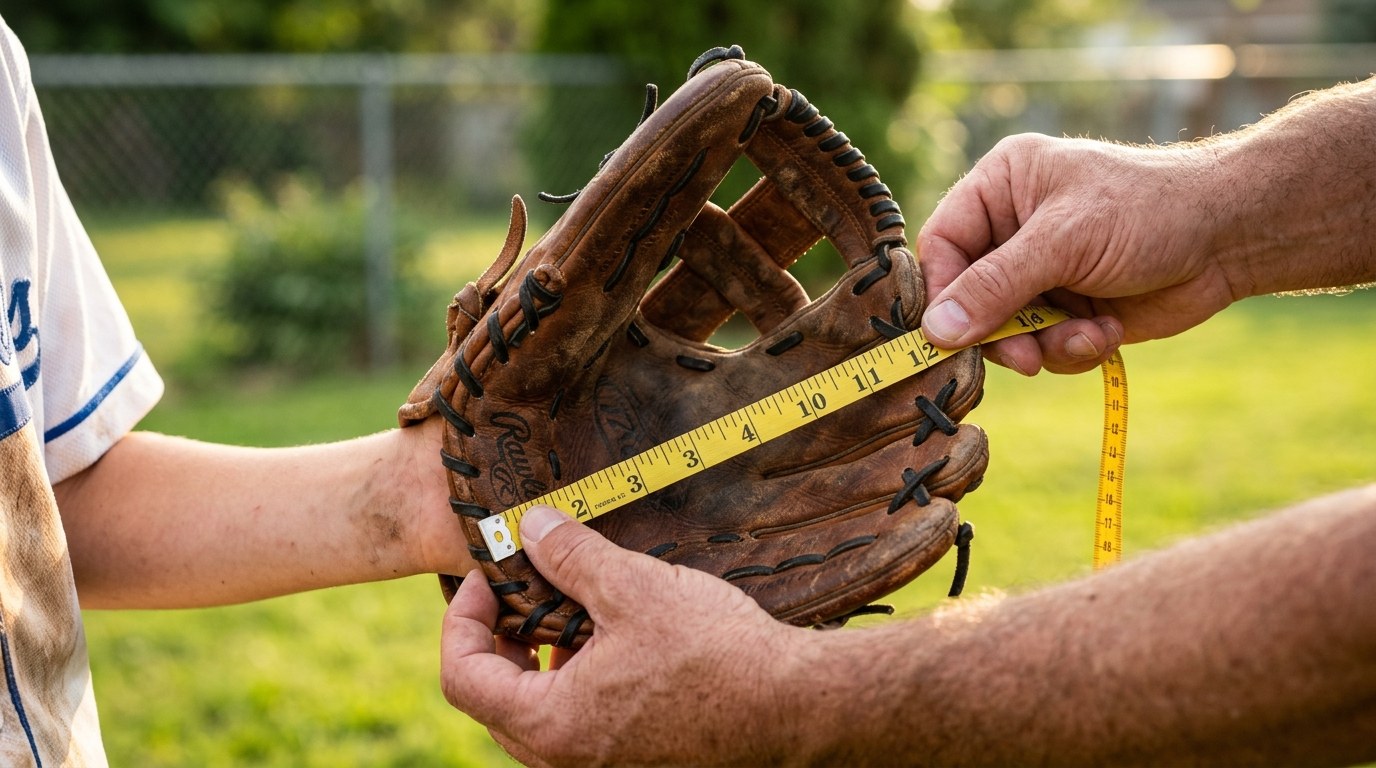
Measuring a glove. Place a flexible tape at the center of the heel (the bottom of the palm) and run it to the tip of the index finger stall — the longest point of the glove. That number in inches is the glove’s listed size. Manufacturers mark it on the thumb or pinky stall leather; if a used glove has no marking, measure rather than guess, because a “10.5” that has been re-laced and re-oiled for years may have shrunk toward 10.
Measuring a hand. Run the tape from the base of the index finger (where it meets the palm) straight down to the bottom of the palm, at the wrist crease. That distance in inches is the glove size the hand wants. It’s a starting point, not a law — hand shape varies more than charts admit, and a player who catches with two hands has more tolerance than one trying to snare one-handed at shortstop.
The chart and the hand disagreeing by half an inch is normal. When it happens, take the size the hand measurement suggests for infield, and the size the age chart suggests for outfield, where reach matters more than closing speed.
Position sizing: why the shortstop and the right fielder buy differently
Infield. Smaller is faster. A glove that closes quickly transfers the ball to the throwing hand quicker, and the throw, not the catch, is where youth plays die. The classic youth infield pattern is an 11 or 11.25 inch glove with an I-web or a shallow H-web — open enough to see through on pop-ups, shallow enough to keep the ball from hiding.
Outfield. Reach wins. Half an inch to an inch longer than the infield pattern, with a deeper pocket — trapeze or modified trap webs are the standard shapes. A 12-incher on a 10-year-old’s hand usually means the player can’t close it; that’s the age chart saying not yet, not the player failing.
Pitcher. Comfort and concealment. Pitchers traditionally favor closed webs (basket or two-piece) because the web hides the grip from the batter, and sizing tracks the infield pattern. Nothing about a pitcher’s glove needs to be special at youth level except the web style and, in most leagues, the color rules — white and grey are restricted on the pitcher’s glove in older divisions because a white glove disappears against the ball.
First base. A mitt, not a glove — no fingers, a longer shallow scoop, listed 11.5-12 inches at youth level. If the player rotates between first and the field, a stretched 11.5 inch infield glove is the compromise; a dedicated mitt only makes sense once the position sticks.
Catcher. Measured by circumference, heavily padded, fingerless. Youth catcher’s mitts run 30-32 inches with quick-release closures. Sizing a catcher’s mitt off the position chart is the right move, but the rest of the kit matters more than the mitt at young ages — our catcher’s gear guide covers the helmet-and-chest-protector sizing that actually protects the player.
The too-big-glove trap
Parents buy two sizes up for three reasons: growth spurts, budget pain, and the belief that a bigger target helps. The first two are real; the third is backwards at every age where it’s usually tried. A youth player with an oversized glove loses closing strength, loses wrist control on ground balls, and compensates by fielding with two hands in positions where one-handed range is the point.
The honest sizing rule: buy for the current season with maybe a half inch of headroom, not for the age two years out. Leather breaks in around the hand that wears it — a glove broken in by a 10-year-old keeps that wide, floppy shape forever, and handing it down to the 12-year-old sibling rarely works as well as parents hope. The exception worth knowing: some youth lines ship with adjustable wrist closures that buy a season of fit without changing the pocket size, which is the cheap version of headroom.
There’s also a substitution trap in the other direction. A 9-inch plastic T-ball glove on an 8-year-old moving into kid-pitch is a resignation letter — the ball comes in harder, the pockets on synthetic entry gloves collapse, and the player learns to fear ground balls that a $40 leather glove would have handled. Moving up a material class at the right time matters more than moving up a size.
Break-in and care, honestly
Manufacturer guidance on break-in is consistent and unspectacular: play catch, a lot. Supplemental tricks that have real-world consensus behind them: a small amount of glove conditioner worked into the palm and hinges (sparingly — soaking leather swells and shortens its life), a ball in the pocket with the glove banded overnight to set the shape, and repeating both for a few weeks. Oven methods, microwave methods, and soaking methods float around every clubhouse; manufacturers advise against all three because heat and water ruin the leather’s temper, and a ruined temper can’t be fixed.
Care is simpler: keep the glove dry, never leave it in a hot car, condition it a couple of times a season, and re-lace when a lace frays — a $5 lace kit beats a cracked glove panel from playing with one lace missing. A youth glove properly kept lasts through one player’s whole run of a size, which is what makes the hand-me-down market so large and, per the section above, so often disappointing.
What a proper glove costs
Retail pricing bands as of late 2026, from listings across major retailers:
- T-ball and entry youth (synthetic, 9-10.5”): $20-40. Fine for ages 4-6. Browse youth gloves on Amazon.
- Real leather youth (10.5-11.5”): $50-100. The Rawlings Sure Catch / Mizuno Prospect class of glove — this is the sweet spot for the 9-12 crowd and the tier where leather break-in starts to matter. 11 to 11.5 inch youth gloves.
- Steer-hide adult patterns (11.5-13”): $150-300+. The A2000-class tier. Overkill for most youth hands, which is a statement about leather stiffness, not quality — premium hides need months of reps to break in, and youth hands don’t supply them.
- Specialty mitts: youth first-base mitts and catcher’s mitts run $50-120 at the same quality tiers. Youth catcher’s mitts, youth first base mitts.
- Conditioner and laces: $8-15 each, the cheapest gear on the page and the difference between a glove lasting one season and three.
When a new glove is the wrong purchase
When the current glove still closes. If the player can close the current glove around a ball with the off hand helping, another season in it is fine — sizing urgency is a closing problem, not a calendar problem.
When the problem is positioning, not the glove. A player fielding everything off to the side has a footwork problem a new glove won’t touch. Fix the drills first — our backyard batting cage and practice setups and swing analyzer tools cover the feedback loop, and reps beat retail every time.
When safety is the actual concern. Gloves don’t protect anything except the hand catching the ball. If the worry is impact safety — a young catcher taking foul tips, a player facing faster pitching — the money belongs in the helmet, mask, and chest protector tier, where our kids’ sports safety gear guide covers what actually protects.
Frequently Asked Questions
How do I know my baseball glove size without measuring? Age is the fallback: 9-10 inches at T-ball age, 10.5-11 inches at 7-8, 11-11.5 inches at 9-12, and 11.5-12 inches as a teenager for infield. It’s crude but it beats guessing, and the position chart refines it.
Is a bigger baseball glove better? Only for outfielders, and only once they can close it. For infielders a bigger glove is slower to close and slower to transfer — the two things youth infield play depends on.
What size glove does a 10 year old need? An 11 to 11.5 inch glove for most positions, with 11.25 as the safest single answer: big enough for outfield duty, still closable for infield. Hand-me-downs in the 12-inch range are usually too much glove for this age.
Do baseball and softball gloves differ? Yes. Softball gloves run longer (12-14 inches) with deeper, wider pockets for the 12-inch ball. A baseball glove on a softball field means dropped balls on routine catches at the bigger sizes.
How long does it take to break in a glove? Weeks of playing catch, with conditioner and overnight ball-in-pocket shaping to help. There is no safe same-day method — heat and water speed up break-in by destroying the leather.
Related Articles
How we evaluate: We combine manufacturer documentation, independent user feedback, and parent-focused criteria like safety, durability, ease of use, and long-term value.
Accuracy note: Pricing and product availability can change. Verify details on the retailer site before purchase.
Affiliate Disclosure: Sports Gadget Review is a participant in the Amazon Services LLC Associates Program. When you purchase through links on this page, we may earn a commission at no extra cost to you. Editorial recommendations are made independently.