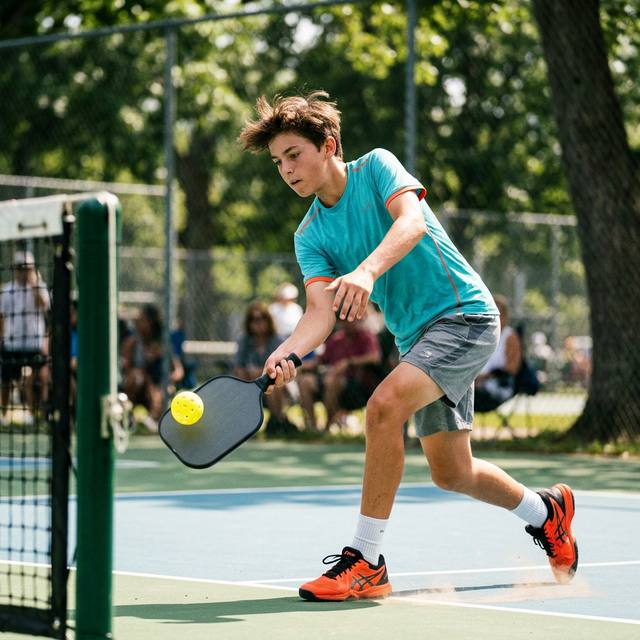
This page is the intermediate / all-court carbon paddle guide: face material, static weight vs swing weight, and grip twins that decide whether a $200 listing plays like a kitchen-control paddle or a baseline driver. It is not a youth-only paddle redo and not a first-composite shopping list.
First $60–$80 composites and “I just joined open play” shapes live on pickleball paddles for beginners. Kid length, 6.5–7.5 oz youth faces, and PE-class kits stay on youth pickleball paddles. Budget accessories that are not a paddle stay in the youth sports gear under $100 roundup.
Desk research only: manufacturer construction notes (thermoformed vs cold-pressed, 14 mm vs 16 mm cores, elongated vs widebody), USAP / UPA-A approval language, and the Amazon title mash-up those families create. Not a lab test this desk ran, not 90 hours of on-court radar, and not a star rating. Published spin and exit-speed marketing numbers are manufacturer or reviewer-site claims — treat them as class, not a score invented here.
Listing check: Amazon “best pickleball paddle 2026” and “raw carbon thermoformed” results mix (1) Selkirk Vanguard Control vs Vanguard Power / Invikta (same family photo, different job), (2) JOOLA Perseus (elongated) vs Scorpeus (widebody) under a Ben Johns hero shot, (3) Friday Original Carbon two-packs next to a single “Pro” sibling, (4) SLK Halo Control vs Halo Power, (5) a 16 mm control core photographed on a 13–14 mm “power” variation, and (6) fiberglass or graphite faces titled “raw carbon.” Confirm face material on the spec row, core thickness, shape (16.5” elongated vs standard), grip circumference, and a current USAP or UPA-A approved line — not a “tournament legal” adjective. Street prices move; treat any dollar figure here as a listing check, not a lock.
Who should buy this — and who should skip
Intermediate rec and club players. You already reset at the kitchen and want a raw-carbon or thermoformed face that still lets you drop a third shot. This is the page.
Advanced / league drivers. You are shopping elongated reach, higher swing weight, and a thermoformed pop. Read the Perseus / Bantam / Gearbox rows, not the beginner guide.
Skip first. Skip a $250 thermoformed paddle if you are still learning to keep a dink in the kitchen — that job is the beginner paddle guide, not a grit-face upgrade. Shopping for a junior player instead? The youth pickleball paddles and starter gear page covers junior grip sizes and complete starter sets. Skip a youth-length / sub-7 oz “junior” listing if the player is an adult in open play; that redo lives on youth pickleball paddles. Skip a second paddle “for spin” when the first one is still a fiberglass composite you have not worn in. Skip wood or $25 injection-molded faces if you already play twice a week — those are backyard toys, not this aisle. Skip any listing whose photo is carbon and whose spec row says fiberglass.
Face, weight, and grip (the twins Amazon hides)
Three variables decide the paddle. Amazon titles flatten all three into “raw carbon power.”
Face material. Raw / toray-class carbon grit holds the ball long enough to roll a serve or a flick. Fiberglass and painted graphite pop more and spin less, then wear smooth faster. “Carbon friction” and “T700 raw carbon” are marketing cousins, not identical weaves. If the bullet list never names the face, assume it is not the grit paddle in the hero shot.
Static weight vs swing weight. Scale weight is usually 7.7–8.4 oz in this aisle. Swing weight is how that mass sits. Elongated 16.5” faces put more mass in the tip: more drive, slower hands at the net. Widebody / standard faces keep the mass closer to the handle: faster hands, less plow. Two paddles at 8.0 oz can feel a class apart.
Grip twins. Circumference (about 4.0–4.5”) and handle length (about 4.8–5.5”) are separate SKUs on some brands and a buried dropdown on others. Tennis converts who want a two-handed backhand need the longer handle. Table-tennis converts usually want more face, not more handle. An XL grip in a standard-grip photo is the listing-check fail.
Core thickness. 16 mm polypropylene is the control / reset class. 13–14.3 mm is the power / singles class. Hybrid mid-14s (Bantam ALW-C territory) sit between. Thermoforming wraps the face over the edge and usually adds perimeter foam — stiffer, larger apparent sweet spot, easier to pop a ball long if your swing is already big.
That is the unique value vs Amazon “maximum spin and power” copy. The copy sells a trophy. The twins tell you whether it will sit in the kitchen.
Shape and construction (jobs, not trophies)
| Job | Shape / build | Typical fail |
|---|---|---|
| Kitchen resets, doubles | 16 mm, standard or widebody, cold-pressed or mild thermoform | Buying Perseus reach for a dink game |
| All-court / mixed | Mid-14 to 16 mm, moderate swing weight | 13 mm “power” that sails every drop |
| Singles / baseline drive | Elongated, thermoformed, higher swing weight | Fatiguing hands in a 90-minute doubles stack |
| Rec upgrade from wood | Budget T700 thermoform under $100 | Paying $280 before you have a third-shot |
USAP or UPA-A approval is the tournament filter. A “pro series” title is not a stamp.
Paddle shortlist (published construction, not a radar card)
1. Selkirk Vanguard Control — kitchen / reset
 Best for Control
 Selkirk
Selkirk Vanguard Control
16mm polypropylene, raw carbon, traditional (non-thermoformed) control face
Selkirk publishes the Vanguard Control as a raw-carbon, 16 mm polypropylene, non-thermoformed control paddle. That is the opposite of the trampoline pop on a foam-edge Gen 3. Owner reports that repeat: wide apparent sweet spot, muted drives, and a face that wants you to swing through a serve instead of punching it.
Buy it when doubles and third-shot drops are the week, not put-aways.
Skip it when the listing is Vanguard Power or Invikta in a Control photo, or you wanted elongated singles reach.
2. JOOLA Ben Johns Perseus 3 — spin / elongated drive
 Best for Spin
 JOOLA
JOOLA Ben Johns Perseus 3
Elongated carbon-friction face; confirm Gen 3 / Perseus 3, not Scorpeus
JOOLA’s Perseus line is the elongated, charged-core / carbon-friction family. Reach and leverage are the point. Scorpeus is the widebody twin in the same athlete photo — different hand speed, different miss. Confirm Perseus 3 / Gen 3 on the variation, not a leftover Gen 1A or a Scorpeus tile.
Buy it when you already drive through the ball and want dip more than a plush reset.
Skip it when kitchen hands are still late. An elongated, stiffer face makes a long dink longer.
3. Paddletek Bantam ALW-C — hybrid all-court
 Best All-Court
 Paddletek
Paddletek Bantam ALW-C
14.3mm Bantam core — the mid-thickness all-court twin, not a 16mm control
Paddletek publishes the ALW-C around a 14.3 mm Bantam core and a tri-tension carbon face. That thickness is the hybrid: more rebound than a 16 mm Selkirk Control, more touch than a thin 13 mm power paddle. Maneuverable in hand battles if the swing weight stays in the mid class.
Buy it when you play both singles and doubles and do not want a dedicated drive paddle.
Skip it when you needed a 16 mm reset paddle or the dropdown is a different Bantam thickness.
4. Friday Original Carbon — budget raw-carbon twin
 Best Value
 Friday Pickleball
Friday Original Carbon
T700 thermoformed carbon; confirm two-pack vs single and the current grit SKU
Friday’s Original Carbon is the thermoformed T700 listing that undercuts $200 faces. Two-pack pricing is how rec pairs upgrade together. The core is usually a bit stiffer than a cold-pressed Selkirk Control — kitchen work takes a shorter swing, not a bigger one.
Buy it when you are leaving wood or cheap composite and want a real carbon face without a $250 miss.
Skip it when the tile is a later “Pro” / thicker sibling you did not compare, or you needed a named USAP stamp for league play and the listing does not show one.
The rest of the eight (class notes)
Six Zero Double Black Diamond (DBD) — Toray T700, 16 mm thermoformed. Control-leaning thermoform. Confirm DBD vs a thinner Six Zero power sibling.
Gearbox Pro Control — solid / raw carbon, high swing-weight class. Power with a “Control” name. Confirm Pro Control vs the power twin.
Selkirk SLK Halo — T700 raw carbon, 16 mm Rev-Core class, lighter swing than Vanguard Power. Halo Control vs Halo Power is the twin.
ProKennex Kinetic Pro — carbon/fiberglass hybrid with Kinetic mass in the handle. Different feel than a full raw-carbon grit face. Confirm Kinetic Pro vs a cheaper ProKennex composite.
| Paddle | Face / core class | Shape | Who it is for |
|---|---|---|---|
| Selkirk Vanguard Control | Raw carbon, 16 mm, not thermoformed | Standard | Doubles resets |
| JOOLA Perseus 3 | Carbon friction, charged / thermoform | Elongated | Drive + roll |
| Paddletek Bantam ALW-C | Tri-tension carbon, 14.3 mm | Standard / hybrid | All-court |
| Friday Original Carbon | T700 thermoform | Standard | Rec carbon upgrade |
| Six Zero DBD | T700, 16 mm thermoform | Standard | Control thermoform |
| Gearbox Pro Control | Toray / solid carbon | Heavier swing | Pace-first |
| Selkirk SLK Halo | T700, 16 mm Rev-Core | Lighter swing | Rec control |
| ProKennex Kinetic Pro | Carbon/fiberglass + Kinetic | Standard | Hybrid feel |
What thermoforming changes (and what it does not)
Traditional paddles are a honeycomb core with faces glued on and a plastic edge guard. Thermoformed paddles wrap the face over the edge under heat and usually inject perimeter foam. Published results: stiffer response, less edge delamination, and a larger apparent sweet spot because the foam weights the perimeter.
What it does not do: turn a beginner into a 4.5. A stiffer face punishes a long swing at the kitchen. If drops are still sailing, a 16 mm cold-pressed control paddle is the skip-buy on thermoform, not a cheaper Friday as a “starter thermoform” you hope to grow into.
Frequently asked questions
How long does a raw carbon face keep its grit?
Owner reports that repeat: frequent play (three-plus times a week) wears peak grit on the order of a season, not a decade. The paddle stays structurally fine; the weave polishes. A rubber eraser made for paddle faces lifts ball plastic. Household glass cleaner is how grit dies early.
Should I choose 14 mm or 16 mm?
16 mm if doubles and resets are the week. 14 mm (or a mid-14 hybrid) if you already drive and play singles. Thickness is not a skill trophy.
Do I need a longer handle?
Only if you come from tennis and use two hands, or you want more whip on a drive. Everyone else should buy face area and a grip that passes the finger-gap test: one index finger of the off hand fits between fingertips and palm.
Related Articles
How we evaluate: We combine manufacturer documentation, independent user feedback, and parent-focused criteria like safety, durability, ease of use, and long-term value.
Accuracy note: Pricing and product availability can change. Verify details on the retailer site before purchase.
Affiliate Disclosure: Sports Gadget Review is a participant in the Amazon Services LLC Associates Program. When you purchase through links on this page, we may earn a commission at no extra cost to you. Editorial recommendations are made independently.