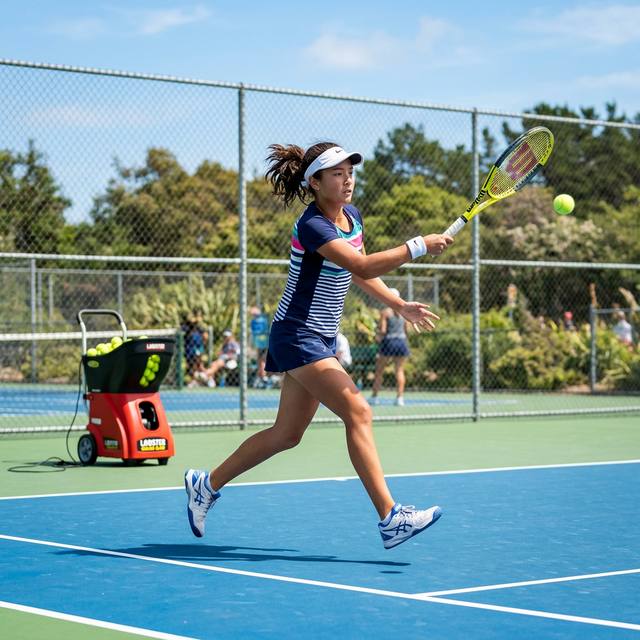
A tennis ball machine is a feed, not a coach. It throws the same ball to the same spot so a junior can groove a swing. That is useful after the player already knows how to make contact. It is an expensive way to learn the sport from zero.
This page is the youth / junior machine guide: portable launchers, beginner toss machines, and when a programmable unit is actually worth the trunk space. The adult-beginner comparison (Lobster, Wilson, T-One capacity charts) lives on tennis ball machines for beginners. Racket sensors are a different aisle: smart tennis racket sensors. Smaller gadgets sit on tennis training gadgets.
This is desk research — manufacturer specs, owner complaints that repeat, and how Amazon titles mix products. Nobody on this desk spent months hitting with every launcher.
Listing check: Amazon “tennis ball machine” results mix a Slinger Bag-style suitcase launcher, a Sports Tutor Tennis Twist toss machine, pickleball launchers, ball hoppers, and unbranded oscillating guns. Confirm the sport (tennis, not pickleball), the feed (it launches, it is not a pickup tube), and whether the battery is included or sold separately.
Who should buy this — and who should skip
Parents. Buy a machine only if court time exists without a hitting partner and someone will charge it, fill it, and pick up 70–140 balls afterward. A $350–1,000 launcher that lives in the garage does not create a junior player.
Coaches / clubs. A programmable unit is a shared station. One Spinshot-class machine for a roster beats three suitcase launchers that each need a phone app and a parent.
Skip first. Skip the machine if the player is still on foam or red-ball and cannot make contact off a toss. Skip it if you actually wanted a rebounder net or a ball hopper. Skip a programmable $2,000 unit if the only drill is “feed me forehands.”
What to check on the listing
- Toss vs match-speed feed. A Tennis Twist throws a 12–20 foot toss every five seconds. A Slinger or Spinshot feeds groundstrokes. Those are not interchangeable.
- Youth / transition balls. Orange and green-dot balls are larger or lower-compression. Confirm the hopper and wheels will feed them. Many “junior” titles still assume a standard yellow ball.
- Weight and who lifts it. Suitcase launchers roll. Metal programmable units are 40+ lb boxes. If the 13-year-old is the only person at the public court, weight is the spec.
- Battery line item. Spinshot-class listings often sell the battery pack separately. A “$1,999 machine” that still needs a battery is not a complete cart.
- Pickleball sibling. The same photo style is used for pickleball launchers. If the title says pickleball, close the tab.
Slinger Bag-class launcher — portable first
Search Slinger Bag tennis launcher. The useful unit is a wheeled suitcase that is the machine and also holds balls and a racket. Live search results also include tennis bags with no motor. Open the listing: you need a feed-rate dial and a hopper, not just a garment bag.
Buy it when a parent (or older junior) will roll it from a car to a public court and run groundstroke / volley feeds. Capacity on current Slinger-class units is typically well over 100 balls. Street prices move; treat any number you see as a listing check.
Skip it when the player is under 10 and needs a soft toss, not a 40 mph feed. That is the Twist’s job. Also skip if nobody will pick the balls up — a 144-ball hopper is a 144-ball chore.
Sports Tutor Tennis Twist — first toss machine
The Sports Tutor Tennis Twist is a ~10–11 lb beginner tosser: 28-ball spiral hopper, a ball every five seconds, 12–20 foot toss. Manufacturer copy (Sports Tutor, checked against the live Amazon title) is honest about the job: driveway, basement, or mini-court for a child who can swing. Battery models run on D cells; AC models exist. It will also toss tennis balls for a first baseball swing. It will not prepare a 14-year-old for a match feed.
Buy it when the player is roughly 5–10 and the goal is contact, not rally pace.
Skip it when you wanted topspin, oscillation, or a 70-ball session. That is a different machine.
Spinshot Player — programmable, not a first buy
The Spinshot Player is the heavy, app-programmed unit: ~120-ball hopper, topspin / backspin / flat, remote feed from the baseline. The on-site product card is the Spinshot Player review. Owner notes that repeat: the battery pack is often a second SKU, the box is not a kid-carry, and Wi-Fi drops happen.
Buy it when a competitive junior already grooved strokes and a coach or parent will write drills — not when you hope the app will coach.
Skip it when the household has not already used a portable launcher for a season. Programmable patterns multiply a routine. They do not create one.
Parent cart vs coach cart
Parent cart: Twist if the child is still learning contact; Slinger-class if they already rally and you have a court you can drive to. Stop. Do not add a racket sensor the same week. Sensors belong on smart tennis racket sensors after the player will actually look at a session.
Coach cart: one programmable machine the staff will run twice a week, plus a hopper. Shared metal beats three suitcase apps.
More tennis tools — rebounders, radars — are on tennis training gadgets. Team-wide browsing is on the training aids hub.
Frequently Asked Questions
Can you use pressureless balls?
Yes, and they are the usual recommendation for machines because the bounce stays consistent as the hopper empties. Confirm the listing says the wheels / belts accept pressureless and youth transition balls if that is what you own.
How long do batteries last?
Manufacturer ranges are typically a couple of hours on a suitcase launcher and longer on a Twist with fresh D cells. Programmable units depend on whether you bought the battery pack. Check the variation dropdown, not the hero photo.
Will a machine help a junior more than lessons?
It helps only as extra feeds between lessons. A machine that nobody fills is a storage problem. Lessons still teach contact and footwork; the machine repeats them.
Is a $350 Twist enough, or do I need a Slinger?
If the player cannot yet time a tossed ball, the Twist is the whole cart. A Slinger-class feed too early produces late, defensive swings and a frustrated parent picking up balls.
Related Articles
How we evaluate: We combine manufacturer documentation, independent user feedback, and parent-focused criteria like safety, durability, ease of use, and long-term value.
Accuracy note: Pricing and product availability can change. Verify details on the retailer site before purchase.
Affiliate Disclosure: Sports Gadget Review is a participant in the Amazon Services LLC Associates Program. When you purchase through links on this page, we may earn a commission at no extra cost to you. Editorial recommendations are made independently.