Part of our youth basketball training gear hub — see /basketball/ for the full lineup.
Related guides:
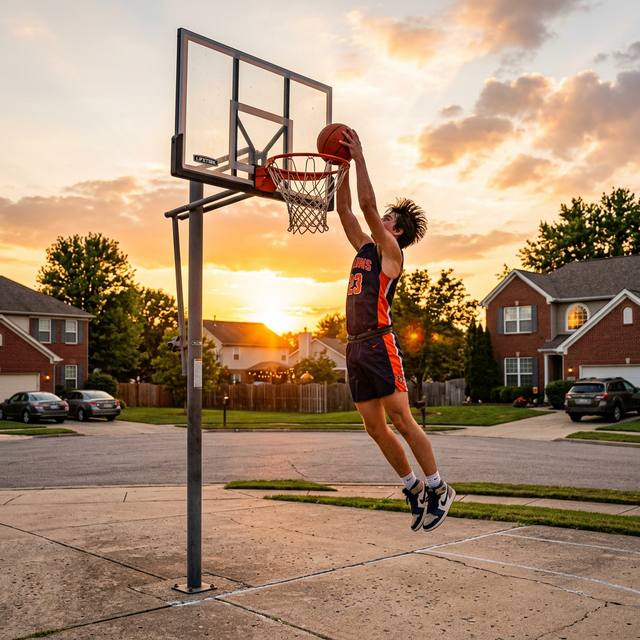
If you are upgrading a driveway court and want the hoop to feel like the one in a gym — solid rebound, zero wobble, no base full of sand or water — the in-ground basketball hoop is still the endpoint of the category. Nothing else in residential hoops matches the rigidity of a steel pole set in concrete, and nothing else holds its adjustment mechanism, rebound quality, and alignment for a decade of daily shot attempts.
As an Amazon Associate we may earn a commission from qualifying purchases made through links on this page, at no extra cost to you.
This guide is research-based rather than hands-on: it synthesizes manufacturer specifications and installation documentation from major hoop makers, standard basketball governing-body rules, and the recurring themes in verified owner reviews. Where a number matters, it is attributed to its source. If you want our model-by-model shortlist, that lives in Best In-Ground Basketball Hoops for Driveways — this page is the how-it-works and how-to-choose companion.
Why an in-ground hoop is still the gold standard
Every residential hoop is a trade-off between stability, portability, and price. Portable hoops win on “you can roll it away,” and a well-chosen portable can be surprisingly playable — we cover the stability math in our portable basketball hoop guide. Wall-mount hoops win when there is no ground to use. But an in-ground system wins on everything that affects how the ball actually comes back to you: pole rigidity, backboard flatness, and the absence of a plastic base that rocks on every drive.
The core mechanical argument is simple. A portable hoop’s pole sits on top of a base filled with water or sand, and that entire mass is what resists movement — which is why even heavy portables transmit vibration into the backboard on hard shots. An in-ground pole is encased in a concrete footing, so lateral forces resolve into the ground itself. That is the same reason gym systems are mounted to structural steel: less energy lost to movement means a truer, more consistent rebound.
If you are still deciding between the two formats, our in-ground vs portable comparison walks through cost, permanence, and driveway-use cases in more detail. The rest of this page assumes you have decided to dig.
The five specs that separate good in-ground hoops from great ones
1. Backboard material: glass, acrylic, or polycarbonate
Backboard material is the single biggest driver of both price and rebound feel.
- Tempered glass is what competitive play uses. It is dense, perfectly flat, and gives the crisp, predictable rebound players expect indoors. It is also the heaviest and most expensive option, and it demands a stouter pole and anchor to carry the load.
- Acrylic looks like glass at a distance and is the most common mid-range material. It is lighter and cheaper, but it flexes more, dulls the rebound slightly, and can develop hazing and fine scratches over years of outdoor use.
- Polycarbonate is the most impact-resistant and least expensive. For young players who mostly shoot close-range shots, it is perfectly serviceable; for teens who fire hard off the glass, the rebound is noticeably “dead” compared to glass.
Owner reviews repeat the same pattern across brands and years: buyers of acrylic and polycarbonate boards rarely regret them for casual family play, while buyers who upgraded to glass almost universally describe it as the moment the driveway hoop started feeling real. The honest caveat is weight and installation difficulty — glass backboards in the 60-inch class are heavy enough that hoisting them onto the pole is a multi-person job.
2. Backboard size: 54, 60, or 72 inches
Regulation backboards are 72 inches wide by 42 inches tall — the NBA rulebook specifies those dimensions along with the 10-foot rim height every level of the sport plays on. For a home driveway, 72 inches of glass is a genuine luxury that also needs a lot of flat playing surface in front of it.
Most families land on 54 or 60 inches. A 54-inch board is forgiving of tight driveways and younger shooters; 60 inches is the sweet spot for a two-car driveway with a player who is growing into bank shots and corner work. We break the trade-off down shot-by-shot in our 50 vs 54 backboard comparison, and the same logic extends one step up to 60.
3. Overhang (the distance from pole to backboard)
Overhang — sometimes called offset — is how far the backboard sits in front of the pole. NBA court geometry puts the backboard four feet off the baseline, which is why under-the-room play is possible without meeting the support structure. Residential systems range from roughly 24 inches on budget models to 36 inches and beyond on premium ones.
More overhang means safer layups and less pole contact, but it also means the pole sits farther back, so you need driveway depth to spare. If your playing area is short, a big overhang can push the rim too far into the lane of the driveway. Measure your space before you shop, not after.
4. Pole construction: one piece beats three
In-ground poles come as one-piece or multi-section designs, in 4x4, 5x5, or 6x6 square steel profiles of varying wall thickness. The differences compound:
- One-piece poles have no joints to flex or work loose, which is why premium brands like Goalrilla build their flagship systems this way and back them with lifetime warranties.
- Three-piece poles ship in a manageable box and are far easier for two people to assemble, and at youth shooting forces they perform fine. The joints are simply the first place vibration reappears as players get stronger.
Wall thickness matters as much as profile size — a thicker-gauge 5x5 pole will typically out-stiffen a thin-walled 6x6. Manufacturers publish pole gauge in their spec sheets, and it is worth reading that row closely on otherwise similar-looking models.
5. Height adjustment: crank, handle, or gas spring
Every quality in-ground system adjusts from 7.5 feet (the standard entry setting for young players) to the regulation 10 feet. What differs is the mechanism: a worm-gear crank is slow but essentially tamper-proof and kid-safe; pneumatic and gas-assist handles are fast one-handed adjustments. Our picks by mechanism are in Best Driveway Adjustable Basketball Hoops, and if you are calibrating for a specific age group, our youth hoop height by age guide follows USA Basketball and NBA guidelines by grade.
Installation: what you are actually signing up for
Installing an in-ground hoop is a weekend project plus a curing wait — straightforward, but with a few non-negotiables.
Call before you dig. In the United States, dial 8-1-1 or use call811.com to have underground utilities marked before you break ground. It is free, it is the law in most jurisdictions, and a struck gas or electrical line turns a weekend project into an emergency.
Footing size follows the manual, not the neighbor. Hole dimensions vary by model and pole gauge, so the manufacturer’s installation sheet is the authority — most call for a hole considerably wider than the pole, deep enough to sit below your local frost line, filled with a substantial quantity of concrete. Bypassing the spec to save a few bags of mix is the most common cause of a hoop that leans within a couple of seasons.
Anchor kit or direct burial. Direct burial sets the pole itself in concrete: cheapest and simplest, but the hoop is permanent. A bolt-down anchor kit pours a concrete footing with four heavy bolts, and the pole bolts on top — if you ever move, resurface the driveway, or replace a damaged pole, you unbolt rather than jackhammer. Most premium systems now ship with anchor kits for exactly this reason.
Respect the cure. Concrete is specified by its strength at 28 days — the standard used across the industry and explained by the Portland Cement Association — and while it reaches most of that strength early, manufacturer instructions universally direct you to wait days, not hours, before hanging the system and playing on it. Follow the manual that came with your hoop rather than a generic timeline, and use a properly mixed bagged product such as Quikrete concrete rather than hand-blending.
Plan the pad, not just the hole. You want reasonably level ground, a few feet of clear run-out behind the pole, no low branches or overhead wires in the shooting arc, and enough distance from the garage that an errant bank shot is not a window claim.
What an in-ground hoop really costs
At the time of writing, street pricing clusters into three rough tiers: budget in-ground systems in acrylic or polycarbonate from roughly the mid-hundreds of dollars; mid-range 54-to-60-inch acrylic and entry glass systems approaching the low four figures; and premium 60-to-72-inch tempered glass systems from specialist brands well beyond that. Installed costs add a contractor’s labor and materials on top — commonly several hundred dollars more, varying by region and access. Treat these as planning bands, not quotes: check current pricing on Amazon’s in-ground hoop listings and get local quotes before committing.
The honest framing for budgeting: the hoop is the visible cost, and the footing, the pad, and the labor are the invisible one. Families who enjoy the hoop most are usually the ones who spent on backboard quality and pole rigidity first, and on electronics and accessories never.
Safety and accessories that earn their keep
One accessory is close to mandatory: a pole pad. The pole is steel, it sits exactly where players drive, and a pad turns a shin-height collision from an ER visit into a bruise. Our basketball hoop pole pads guide covers square vs round fit and thickness; pole pads on Amazon run cheap relative to the protection.
Beyond that: keep the playing surface free of gravel and water, enforce a no-hanging-on-the-rim rule (breakaway rims protect the backboard, not the structure from a 160-pound teenager), and give younger players a ball sized to their hands rather than a full-size men’s ball. Summer upgrade path: a pool basketball hoop keeps shot reps going through the off-season without touching your driveway anchor.
Keeping it true: a short maintenance checklist
- Re-check and re-torque the pole, arm, and backboard bolts after the first month of play, then each spring.
- Wash glass and acrylic boards with mild soap and water; skip abrasives and ammonia on anything but glass.
- Inspect the paint near the concrete interface yearly and touch up scratches on the pole to slow rust where steel meets footing.
- Run the height adjustment through its full range occasionally; lubricate per the manual if it starts to feel notchy.
None of this is time-consuming. In-ground systems from established brands routinely outlast the kids who grew up shooting on them — which is the point.
Frequently asked questions
How deep does the hole for an in-ground hoop need to be? Deep enough to reach below your regional frost line and meet the dimension printed in your model’s installation manual — both vary by locale and by pole gauge, so the manual plus a call to your local building department is the correct answer, not a universal number.
Can I install one myself? Yes, with two or three willing people, a rental auger or a good post-hole digger, a weekend for the dig and assembly, and the patience to let concrete cure before play. If your driveway is sloped or your footing needs to be larger than spec-minimum, a contractor with concrete experience is money well spent.
Can an in-ground hoop be moved later? Only if it uses a bolt-down anchor kit — the pole unbolts and can be re-mounted on a new footing. A directly buried pole is a demolition job. If there is any chance of a move or a driveway resurfacing, buy the anchor-kit version.
Is a tempered glass backboard safe around kids? Tempered glass is engineered to fracture into small granular pieces rather than shards if it ever fails, and basketball-backboard glass is a mature, heavily specified product category. The realistic risk to manage is not the glass — it is players colliding with the pole, which is what the pad is for.
How far should the hoop be from the garage or the street? Work backwards from playing room: you want comfortable shooting depth in front of the rim plus overhang behind it, and enough margin that chased balls do not roll into traffic. Measure the full footprint — pole, overhang, and playing area — before ordering anything.
The bottom line
An in-ground basketball hoop is the rare purchase where the boring attributes — footing depth, pole gauge, anchor design — decide whether the exciting ones ever feel good. Buy the backboard material that matches how your family actually plays, insist on a pole stiff enough to hold it, pour the footing the manual specifies, pad the pole, and let the concrete cure. Then expect the hoop to outlast the season, the kid, and probably the car.
Related reading: our in-ground vs portable deep-dive, the best in-ground hoops shortlist, hoop height by age, and the 50 vs 54 backboard comparison.
How we evaluate: We combine manufacturer documentation, independent user feedback, and parent-focused criteria like safety, durability, ease of use, and long-term value.
Accuracy note: Pricing and product availability can change. Verify details on the retailer site before purchase.
Affiliate Disclosure: Sports Gadget Review is a participant in the Amazon Services LLC Associates Program. When you purchase through links on this page, we may earn a commission at no extra cost to you. Editorial recommendations are made independently.