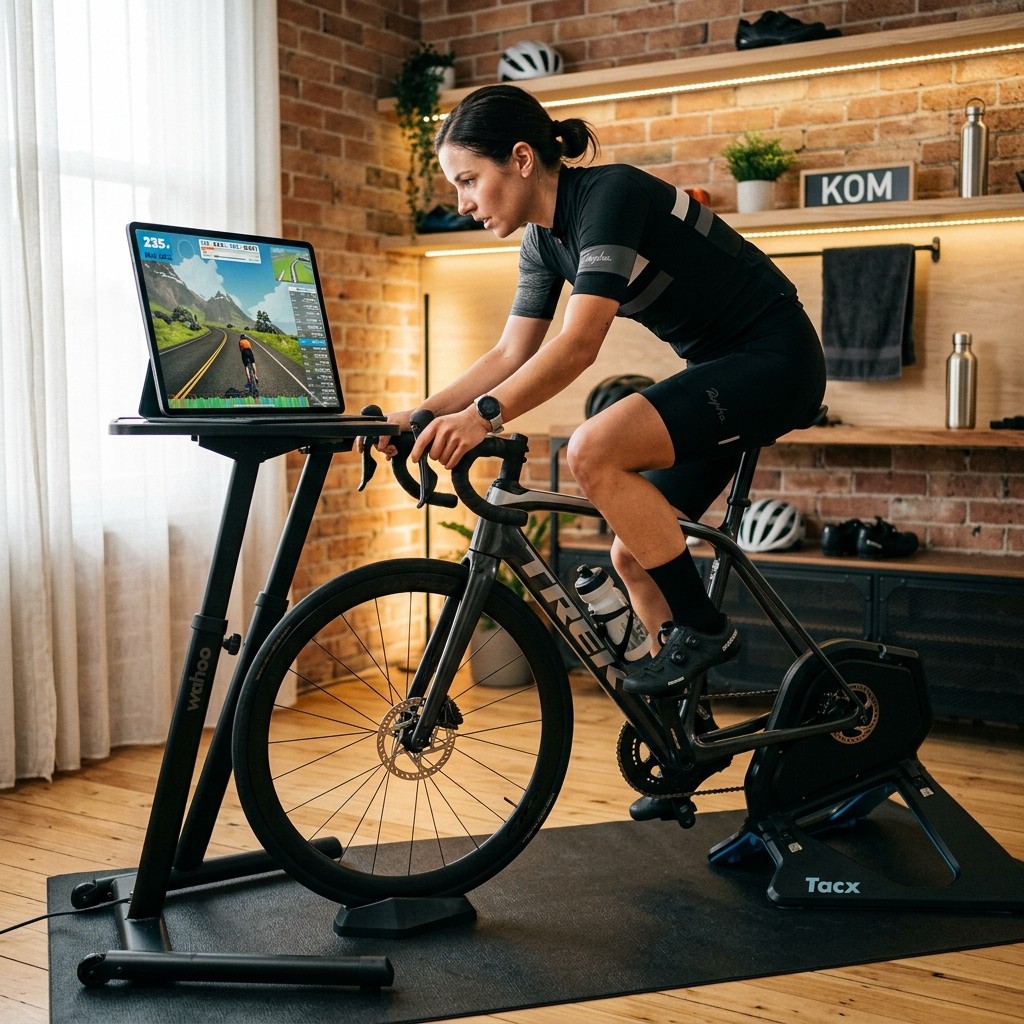
A smart trainer is a resistance unit that talks to Zwift, TrainerRoad, or Rouvy and controls your wattage. A spin bike is a heavy flywheel and a knob. Those are different carts. This page is the Zwift-ready trainer compare: direct-drive vs wheel-on, and the power-accuracy twins Amazon files under one “indoor bike trainer” title.
If the goal is a casual apartment spin with a Netflix show, skip this aisle. If the goal is structured watts or a virtual race, stay here. Pairing a chest strap to the same app is a different job — that lives on heart rate monitors for cycling and the general chest strap vs wrist page. Youth helmets and lights stay on youth cycling and BMX safety tech. A trainer as part of a garage stack is on home gym equipment essentials.
Desk research only: Wahoo and Garmin/Tacx published accuracy, grade, and connectivity sheets, plus the Amazon title mash-up those families create. Not a lab test this desk ran, not 2,000 indoor miles on a fleet, and not a star rating. ±1% / ±2% / ±3% figures below are manufacturer claims, not a meter this desk bolted on.
Listing check: Amazon “smart trainer” and “Zwift trainer” results mix (1) Wahoo KICKR (full, Wi‑Fi, ±1% class) vs KICKR CORE / CORE 2 (mid direct-drive) vs KICKR MOVE (moving axle) vs KICKR BIKE (the full bike, not a trainer) vs KICKR SNAP (wheel-on), (2) Garmin Tacx Flow / Flow 2 (wheel-on) vs Flux vs NEO (direct-drive) in the same Tacx photo, (3) a dumb fluid trainer titled “smart,” (4) a cassette-included bundle vs frame-only, and (5) a spin bike with a tablet tray sold as a smart trainer. Confirm direct-drive vs wheel-on, the accuracy line on the manufacturer sheet, cassette / freehub body (Shimano HG vs SRAM XD / XDR vs Campagnolo), and that the listing is not a KICKR Bike. Street prices move; treat any dollar figure here as a listing check, not a lock.
Who should buy this — and who should skip
Structured / Zwift riders. You already own a bike, you will ride indoors most of the week in winter, and you care whether 200 W in the app is roughly 200 W. Buy a direct-drive unit if the budget can stretch.
Trying indoor riding for one season. A wheel-on smart trainer is the cheaper “does this habit stick?” path. Expect tire noise and a tire you will replace.
Skip first. Skip a smart trainer if the real goal is a casual spin-bike / Peloton-class session with no power file and no virtual course — a connected spin bike or a dumb fluid trainer plus a show is the cheaper honest buy. Skip a second trainer “for accuracy” if you already have a CORE-class direct-drive. Skip KICKR SNAP if the photo is a CORE and you needed quiet. Skip a full KICKR Bike if you already have a road bike that fits. Skip wheel-on if downstairs neighbors are the constraint and you can reach CORE money.
Direct-drive vs wheel-on
Direct-drive ($600–$1,400 class)
You pull the rear wheel and bolt the dropouts onto the trainer’s cassette. The trainer is the rear wheel.
Why people pay it: manufacturer accuracy in the ±1–2% class, no tire-on-roller noise, no trainer-tire wear, and a more stable frame. Grade simulation on Zwift climbs is the published reason for the heavier flywheels.
Cost you actually pay: a cassette if the box does not include one ($30–$70), a longer first setup, and a 40-pound box you will not carry upstairs every Tuesday.
Wheel-on ($300–$600 class)
The rear tire presses on a roller. Clamp, inflate, ride.
Why it exists: lower price, lighter, no cassette homework.
What you give up: manufacturer accuracy in the ±3% class (tire pressure and slip move the number), roller noise, and a rear tire you will cook. Road feel is the “disconnected” complaint that repeats.
Desk recommendation: if indoor riding is the season, buy direct-drive. If you are testing the habit — or you needed a travel trainer — wheel-on is the honest start. That is not “wheel-on is fine for racing.”
Power-accuracy twins (read the sheet, not the tile)
| Claim on the sheet | Typical family | What it is for | Typical fail |
|---|---|---|---|
| ±1% | Wahoo KICKR (full), Tacx NEO class | Zwift racing, dual-record leagues | Buying CORE and expecting the full KICKR card |
| ±2% | Wahoo KICKR CORE / CORE 2 | Structured training, most Zwift | Paying full-KICKR money for a CORE 2 photo |
| ±3% (or “±2.5%”) | Tacx Flow / other wheel-on | Habit / casual ERG | Using it as a race-verification meter |
| No watt number | Dumb fluid / magnetic | Spinning, not Zwift control | Title says “smart” |
Zwift will display watts from any smart trainer that pairs. Displayed watts are not a lab certificate. Competitive Zwift groups that ask for a dual record want a ±1–2% direct-drive plus a separate meter — that is their rule, not a score from this desk.
ERG mode (the app holds a wattage) is only as good as the trainer’s control loop and your cassette setup. A wheel-on that slips at 80 PSI will look “inaccurate” when the tire is the variable.
Shortlist (three jobs)
Best overall direct-drive: Wahoo KICKR (full / current v6-class)
Wahoo publishes ±1%, a heavy flywheel, Wi‑Fi plus Bluetooth plus ANT+, built-in cadence, and steep grade simulation (20% class) on the full KICKR. That is the “indoor is the season” card. Cassette is often not in the box — confirm. Spindown / calibration is a maintenance step, not a defect.
Buy it when you race on Zwift or you already know you will sit on the trainer four days a week.
Skip it when the tile is KICKR CORE, MOVE, SNAP, or BIKE. Those are different SKUs.
Best value direct-drive: Wahoo KICKR CORE (or current CORE 2)
Wahoo publishes ±2%, Bluetooth and ANT+ (no Wi‑Fi on classic CORE), a lighter flywheel than the full KICKR, and 16% class grade on CORE. CORE 2 is the listing twin — same job, newer sheet. Read which one you are paying for. A dedicated ANT+ dongle is the usual fix if Bluetooth to a TV stick drops.
At mid-pack street prices this is the trainer most indoor cyclists should finish on. The jump to full KICKR is polish (Wi‑Fi, flywheel, grade), not a new sport.
Buy it when you want direct-drive accuracy without the flagship box.
Skip it when the photo is a full KICKR or a SNAP and the title says CORE.
Shop Wahoo KICKR CORE on Amazon
Best budget smart (wheel-on): Garmin Tacx Flow 2
Garmin/Tacx publishes the Flow family as a wheel-on smart trainer with app control and a modest max grade (6% class on Flow-generation sheets). That is enough for flat-to-rolling Zwift and ERG intervals. It is not a NEO climb. Noise is the tire-on-roller complaint that repeats; a dedicated trainer tire helps and does not make it a CORE.
Buy it when you need Zwift pairing and you are not ready to pull a wheel every session.
Skip it when apartment noise is the deal-breaker, or the tile is a Tacx Flux / NEO at a Flow price.
Shop Garmin Tacx Flow 2 on Amazon
Side-by-side (manufacturer class, not a meter card)
| Trainer | Type | Published accuracy | Grade class | Connectivity | Weight class |
|---|---|---|---|---|---|
| Wahoo KICKR (full) | Direct-drive | ±1% | 20% class | Wi‑Fi + BLE + ANT+ | ~47 lb |
| Wahoo KICKR CORE | Direct-drive | ±2% | 16% class | BLE + ANT+ | ~40 lb |
| Tacx Flow 2 | Wheel-on | ±3% class | 6% class | BLE / ANT+ (sheet) | ~15 lb |
Prices move. Confirm cassette included, axle adapters (quick-release vs 12 mm thru-axle), and whether you need a SRAM or Campagnolo freehub body.
What else the trainer does not include
- Fan. Indoor heat is the reason people quit. A $40 high-velocity fan is not optional.
- Sweat cover. Sweat into the headset is how a nice road bike becomes a rust project. $15–$25.
- Mat. Protects the floor and cuts rumble. Does not turn 72 dB of tire roar into a conversation.
- Heart rate. The trainer measures power. Zones still want a strap — cycling HRMs.
- Screen. Zwift on a phone is how people stop. A TV or laptop is the habit.
Cassette and axle notes that are not Amazon adjectives
Match the freehub to the bike you will leave on the trainer. A Shimano HG cassette on a SRAM XDR driver does not thread on because the listing said “universal.” Thru-axle vs quick-release adapters are usually in the box; confirm your axle standard (12×142 is the common modern road) before you assume.
A second cheap bike left on the trainer is the quality-of-life buy if you also ride outside. Swapping a wheel every storm week is how the trainer becomes furniture.
Frequently asked questions
Is Zwift worth the subscription?
Zwift is a monthly platform (street price moves; read the current plan). It is worth it if you will ride indoors most winter weeks and you want group rides or structured workouts you will actually start. If you ride indoors twice a month, a free or cheaper ERG app plus a video is the skip-buy on Zwift, not a cheaper trainer.
How accurate does the trainer need to be for Zwift racing?
Casual riding: ±3% class is a ballpark. Racing or a league that dual-records: published ±1–2% direct-drive. This desk did not certify anyone’s race file.
Will a trainer wreck the bike?
Direct-drive load is in the same family as a road. Wheel-on side-load on a cheap skewer is the complaint that repeats — use the trainer skewer they packed. Sweat is the damage people actually buy. Cover the stem.
Can I use a spin bike on Zwift?
Only if that bike has a supported power meter / smart controller. A knob and a tablet tray is not a smart trainer. That is the skip-buy this page exists to name.
Related Articles
How we evaluate: We combine manufacturer documentation, independent user feedback, and parent-focused criteria like safety, durability, ease of use, and long-term value.
Accuracy note: Pricing and product availability can change. Verify details on the retailer site before purchase.
Affiliate Disclosure: Sports Gadget Review is a participant in the Amazon Services LLC Associates Program. When you purchase through links on this page, we may earn a commission at no extra cost to you. Editorial recommendations are made independently.