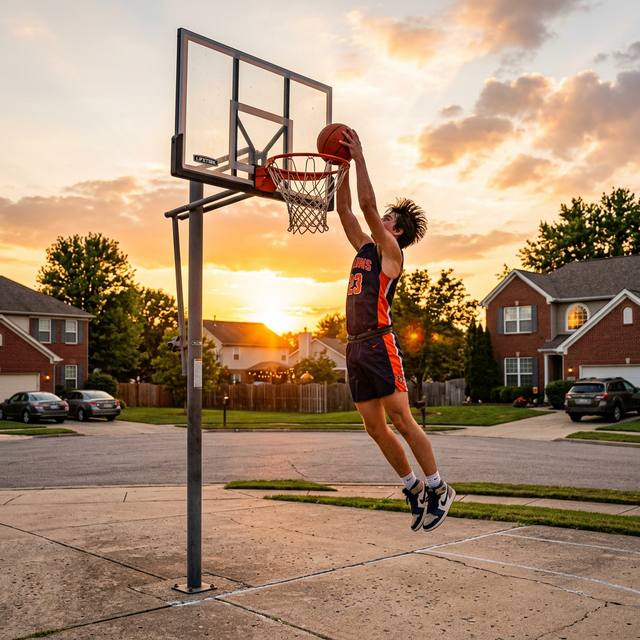
When shoppers search for the best adjustable basketball, they are almost always looking for an adjustable basketball hoop — a driveway or backyard goal system with a mechanism that raises or lowers the rim so players of different ages can share one basket. A standard basketball itself is not height-adjustable; the hoop is. This guide focuses entirely on that: the best adjustable basketball hoops for driveway play in 2026, compared by what actually matters once the box lands on your curb.
If the problem is driveway wobble, UV-yellowing boards, or the height-crank mechanism, the driveway adjustable hoop guide stays on those setup issues. This page is the 2026 pick list across portable and in-ground. Both URLs stay live.
Listing check: Lifetime and Silverback Amazon titles often reuse a parent listing for 50-inch and 54-inch boards. Open the listing and confirm the backboard width, fill type (sand vs water), and the exact height range before you buy. Do not treat a 50-inch child listing as the 54-inch driveway hoop named here.
Our short answer: the best adjustable basketball hoop for most driveways is a stable 54-inch system that adjusts from roughly 7.5 feet to the regulation 10 feet, with enough base or pole weight that it does not sway after a normal jump shot. For most families that means a quality portable hoop in the Lifetime 71524 class. For serious players with a permanent court, an in-ground system like the Goalrilla GS54 delivers the most gym-like rebound. We do not recommend chasing the largest backboard you can afford — a stable 54-inch hoop beats a shaky 60-inch portable on almost every family driveway.
Before the picks, get three things right and you will avoid the most common buying mistakes:
- Who is the main player? Toddlers, elementary-age kids, teens, or adults shape the entire decision.
- Does the hoop need to move? Portable systems serve renters and multi-use driveways; in-ground systems serve permanent courts.
- How much real space do you have? Base footprint, pole overhang, and clearance from garage doors matter as much as backboard width.
Quick Picks: Best Adjustable Basketball Hoops at a Glance
| Need | Best fit | Why it works |
|---|---|---|
| Best adjustable basketball hoop for most driveways | Lifetime 71524 (54” portable) | Strong value, useful 7.5–10 ft range, manageable footprint |
| Best premium portable hoop | Spalding The Beast (60” glass portable) | Larger glass board and heavier base for real practice |
| Best permanent driveway hoop | Goalrilla GS54 (in-ground) | Best stability and the closest thing to a gym rebound |
| Smoothest height adjustment | Spalding crank-lift systems | Fast, secure rim changes for multi-kid households |
| Best first hoop for young kids | Little Tikes Easy Score | Lower 2.5–4 ft rim range for first shooters under 7 |
How We Compared Adjustable Basketball Hoops
A driveway hoop lives in a different world than a full backyard or institutional court, so the buying criteria are different too. We weighted five factors:
- Height adjustment range and mechanism. A family hoop should drop to at least 7.5 feet so younger kids can shoot with real form, and reach the 10-foot regulation rim. USA Basketball’s youth development guidance emphasizes age-appropriate equipment — the official 8 / 9 / 10 foot ladder is in our youth hoop height by age guide — and a hoop that cannot lower the rim forces small players into poor mechanics. The mechanism also matters: a smooth crank or pneumatic lift gets used every day, while a stiff telescoping collar tends to get ignored.
- Backboard material and response. Tempered glass gives the truest, most rigid rebound and is what gym baskets use. Acrylic is the practical middle ground — good rebound at lower weight and cost. Polycarbonate (often sold as “shatterproof”) is the most durable and budget-friendly, but it has a softer, deader rebound. We name the material for every pick below.
- Stability of the base or pole. A hoop that shakes after every shot is not just annoying — it changes the rebound and can become a tip-over risk. We prioritized systems with enough ballast (water- or sand-fillable portable bases) or a proper in-ground anchor. Once the system is planted, pad the post so finishes and rebounds hit foam instead of steel; see basketball hoop pole pads.
- Driveway fit. Backboard width is only one variable. Base depth, pole overhang, and clearance from garage doors and sidewalks matter just as much, and often more, for daily usability.
- Regulation alignment. The NBA rule book sets the rim at exactly 10 feet with a 72-by-42-inch backboard for competition. No affordable residential hoop matches pro dimensions, but knowing the target helps you pick a board size that scales reasonably toward the real thing rather than picking blindly.
This is a research-based guide, not a hands-on play test. We compiled published manufacturer specifications for the major residential hoops, cross-checked them against official basketball regulations, and looked for recurring patterns in owner reviews across major retailers — the things buyers repeatedly praised and the things that broke, leaked, or disappointed. Where a spec or price may have shifted, we link to a live Amazon search so you see current pricing instead of a snapshot that could already be stale.
Best Adjustable Basketball Hoops Ranked
Best Overall for Most Driveways: Lifetime 71524
The Lifetime 71524 is the most practical pick for families who want one hoop that serves several age groups. According to Lifetime’s published specifications, the 71524 pairs a 54-inch steel-framed shatterproof (Makrolon polycarbonate) backboard with a Power Lift height adjustment that moves the rim from 7.5 to 10 feet, a Slam-It Pro rim with double-compression springs, and a heavy-duty portable base designed to be filled with sand or water for ballast.
The polycarbonate backboard is not as rigid as tempered glass, so it is the wrong pick for aggressive dunking or for older players who want a true gym rebound. But for daily shooting, youth workouts, and parent-child driveway games, it hits the best balance of board size, durability, height range, and price in a system you never have to anchor in concrete.
Best for: families who want one reliable, movable driveway hoop without pouring concrete.
Check the current price for the Lifetime 71524 on Amazon
Best Premium Portable Hoop: Spalding The Beast
Spalding The Beast is the portable hoop to consider if you want a more serious driveway setup but cannot (or do not want to) install an in-ground pole. Per Spalding’s specs, The Beast uses a larger 60-inch tempered-glass backboard, a heavy portable base, and an arena-style breakaway rim, which makes it feel far closer to a permanent system than a budget portable hoop.
The tradeoff is weight and mobility. Once the base is filled, “portable” is a technicality — this is a heavy system you position deliberately and leave in place for the season rather than wheel around each afternoon. It fits best on a wide, flat driveway with a dedicated playing area, and it rewards that setup with a noticeably truer rebound than polycarbonate portables.
Best for: teens and competitive players who need a premium, glass-board portable hoop.
Shop Spalding The Beast on Amazon
Best In-Ground Adjustable Hoop: Goalrilla GS54
The Goalrilla GS54 is the pick when the driveway hoop is a long-term, permanent installation. Goalrilla’s documentation for the GS54C lists a 54-inch tempered-glass backboard, a one-piece pole, and an in-ground anchor system with height adjustment — which is exactly why it feels planted and rebounds like a gym basket instead of a portable goal.
The catch is installation. An in-ground system needs a concrete footing, careful placement, and a curing period before play. You also need a spot that will not interfere with parking, sidewalk clearance, or HOA rules. Check every one of those boxes and this is the closest residential option to a real outdoor court basket — and the system we point serious, frequent shooters toward.
Best for: permanent driveway courts and players who practice several times per week.
For a deeper look at permanent systems, our best in-ground basketball hoops guide covers installation, overhang, and glass thickness in more detail.
Smoothest Height Adjustment: Spalding Crank-Lift Systems
Height adjustment matters more than people expect when multiple kids share one hoop. A smooth crank or lift mechanism gets used; a stiff pin or collar system often gets skipped, which leaves younger players shooting at a rim that is too high and developing a flat, pushed release instead of a real arc.
Spalding’s crank-lift systems are a strong fit for households with players at different ages because they move the rim smoothly and hold it securely at any height in the range. Because Spalding uses different lift mechanisms across its portable and in-ground lines, confirm the specific mechanism on the model page before you buy.
Best for: households with several kids shooting at different rim heights.
Shop Spalding crank-lift hoops on Amazon
Best First Hoop for Young Kids: Little Tikes Easy Score
For players under 7, even the lowest setting on a full-size adjustable hoop is usually too tall. The Little Tikes Easy Score is not a training-grade hoop, but it lets the youngest players build coordination and confidence before they graduate to a 7.5–10 foot system. Little Tikes lists six adjustable heights from 2.5 to 4 feet, an oversized rim, indoor/outdoor use, and a roughly 18-month to 5-year age range.
Best for: toddlers and early-elementary players who are not ready for a full driveway hoop.
Check the price for the Little Tikes Easy Score on Amazon
Portable vs In-Ground Adjustable Hoops
This is the single biggest decision, and it shapes every other choice. Our in-ground vs portable basketball hoop guide and best portable basketball hoop for driveways go deep; the short version lives in this table:
| Factor | Portable hoop | In-ground hoop |
|---|---|---|
| Stability | Good when base is full; can shake or tip | Excellent; feels like a gym basket |
| Installation | None — assemble and fill the base | Requires concrete footing and curing time |
| Mobility | Can be moved or stored | Permanent placement |
| Best surface | Flat concrete or asphalt | Flat concrete or asphalt |
| Typical cost | Budget to premium | Mid to premium |
| Best for | Renters, multi-use driveways, and growing families | Homeowners with room for a dedicated court |
One framing that helps: a portable hoop is an appliance you own, and an in-ground hoop is part of the property. If you might move within a few years, share the driveway with cars, or are not sure basketball will stick, portable is the lower-regret choice. If your household already plays daily and you have a slab you can dedicate to it, the in-ground route stops being expensive the moment you stop thinking about resale and start thinking about rebound quality.
Height Adjustment Mechanisms, Compared
The adjustment mechanism is the part of an adjustable hoop you interact with every single day, and it is the spec most buyers skip past. Four types dominate the residential market:
| Mechanism | How it works | Usually found on | Tradeoffs |
|---|---|---|---|
| Telescoping pole with pin | Pull a pin, slide the pole section, re-seat the pin at the next hole | Budget portables | Cheapest and lightest; coarse height steps; often a two-person job |
| Pneumatic (gas-assist) lift | Squeeze a handle and a gas spring counterbalances the backboard | Mid-range portables like the Lifetime Power Lift line | One-handed with near-infinite settings; the gas assist can weaken over years of use |
| Crank handle | Turn a handle that raises or lowers the rim along a screw or cable track | Premium portables and most in-ground systems | Smoothest and most secure at any height; slowest to traverse the full range |
| Hydraulic lever | Pump a lever, similar to an office chair | Selected premium in-ground systems | Fast and low-effort; adds cost and one more serviceable part |
Two practical notes from the owner-review patterns we compiled. First, mechanism quality shows up most at the extremes — a cheap telescoping collar that binds at 7.5 feet is the difference between your youngest kid actually shooting low and the family leaving the rim at 10 feet all season. Second, whatever the mechanism, check where the handle or lever sits relative to the base; on some portables it is low enough that shorter adults have to kneel to crank it.
What Height Should the Rim Actually Be?
An adjustable hoop only pays off if you actually adjust it. The ladder we recommend following is the one in our youth basketball hoop height by age guide, which tracks USA Basketball’s youth development guidance: start early-elementary players around an 8-foot rim, move to 9 feet as they get stronger, and reach the regulation 10 feet only when they can shoot with proper arc and follow-through instead of heaving the ball.
The signal to watch is shot shape, not age. If a young player’s shots flatten out and both hands shove from the chest, the rim is too high for their current strength — lower it and let them learn a repeatable release first. And if you notice a young shooter pushing the ball with their guide hand as they struggle with a taller rim, our guide on how to stop thumb flick in basketball shooting breaks down the fix. Raising the rim a foot is a two-minute job on a good mechanism; un-learning two years of flat shooting is not.
Backboard Size: Is 54 Inches Enough?
For driveway play, 54 inches is the sweet spot for most households — big enough that bank shots and corner-to-corner shooting feel realistic, small enough that the base and pole needed to support it stay manageable. Bigger is only better when the support structure grows with it: a 60-inch glass board on an under-ballasted portable base rebounds worse and wobbles more than a 54-inch board on a properly filled one.
If you are torn between sizes, our 50 vs 54 backboard comparison walks through the shooting-arc and driveway-footprint differences in detail, and the in-ground basketball hoop guide covers how board width pairs with pole overhang once you go permanent.
Filling the Base: Sand vs Water (and What Winter Does to Both)
Portable hoop bases are ballast tanks, and what you fill them with is a bigger decision than it looks.
- Water is free, fast, and easy to pour out. It is also lighter than the same volume of sand, and it expands when it freezes — a water-filled base left outside through a hard freeze is the single most common cracked-base failure pattern in the owner reviews we reviewed. If you get real winters and use water, plan to drain the base before the first hard freeze.
- Sand is the stability choice: it weighs meaningfully more per fill, it never freezes, and it does not slosh. The costs are filling (it is slow and dusty through the small fill port, and manufacturers’ assembly manuals typically recommend getting help or a funnel) and emptying — sand-filled bases are effectively permanent, so a sand-filled portable is a two-to-three-person move even when “empty.”
- Whichever you choose, fill it completely. A half-full base is the root cause behind a large share of the wobble and tip-over complaints in owner reviews. The stability numbers on the box assume a full base.
The same cold-weather logic applies to the rest of the system: UV is the other slow killer, so boards and nets left in direct sun year-round yellow and fray faster than the same gear rotated into shade or a garage for the off-season. A few minutes of seasonal care — full ballast, a wiped-down board, a fresh net, and a pole pad covering the steel — is what separates a hoop that lasts a few summers from one that lasts a decade.
Assembly and Installation: What to Expect
The most consistent complaint across owner reviews of every large portable hoop, regardless of brand, is assembly. These ship as many heavy boxes, the pole sections and base need two adults to manipulate safely, and the work goes faster on a flat slab with all hardware laid out first. Read the assembly steps for the height mechanism before the pole is standing — some lifts need to be set at a specific height during assembly, which is much easier to do right the first time.
For in-ground systems, the sequence is digging to the specified footing depth, setting the anchor or pole in concrete, and waiting out the cure before any play. Our complete in-ground basketball hoop guide covers footing, placement relative to the driveway and overhang, and curing in depth, and the portable basketball hoop guide does the same for positioning and stabilizing a portable base on a sloped or uneven driveway.
Add-Ons That Multiply One Hoop
One adjustable hoop serves the whole household better with a couple of inexpensive accessories:
- A basketball return system sends made shots back to the shooter, which roughly doubles the shooting volume a kid gets in the same driveway session.
- A basketball rebounder for solo practice does the same job for passing and missed shots when nobody else is out there.
- A pole pad is cheap insurance once younger players start driving to the basket on a lowered rim.
Common Adjustable Hoop Questions
Can you dunk on an adjustable driveway hoop? Residential manufacturers almost universally warn against hanging on the rim, and the height-adjustment mechanism is exactly what you are stressing when you do it. Portable systems with filled bases can tip, and even in-ground adjustable systems are not built for the loads of a gym breakaway. If dunking is the goal, lower the rim and work on it there rather than hanging on the goal at any height.
How low do adjustable hoops actually go? Most full-size residential systems stop at 7.5 feet. That is low enough for early-elementary players to shoot with real form, but not low enough for preschoolers — which is why a toy-grade hoop like the Little Tikes Easy Score above exists as a first step rather than a substitute.
Can a portable hoop be converted to in-ground later? Some manufacturers sell in-ground anchor or conversion kits for selected portable models, but compatibility is model-specific. Check the accessory list for your exact model before buying a portable with a later conversion in mind — do not assume one exists.
Is a used adjustable hoop worth it? Only if you can inspect it assembled and filled. The failure points — a stripped lift mechanism, a warped or crazed backboard, a cracked base — are all visible or feelable in two minutes of use, and none of them show in a listing photo of a hoop folded in a garage.
The Short Version
- Most driveways, most families: Lifetime 71524 — 54 inches, 7.5–10 feet, fill the base all the way.
- Serious players who cannot pour concrete: Spalding The Beast — glass rebound, permanent-footprint portable.
- Permanent court: Goalrilla GS54 — plan the footing, then forget about wobble forever.
- Multi-kid households: prioritize the crank or gas-assist mechanism, because a height adjustment that is annoying does not get used.
- Under-7s: Little Tikes Easy Score now, full-size adjustable later.
Related reading: our in-ground vs portable comparison, the best in-ground hoops for driveways, the best portable hoops for driveways, and the full driveway adjustable hoop setup guide.
How we evaluate: We combine manufacturer documentation, independent user feedback, and parent-focused criteria like safety, durability, ease of use, and long-term value.
Accuracy note: Pricing and product availability can change. Verify details on the retailer site before purchase.
Affiliate Disclosure: Sports Gadget Review is a participant in the Amazon Services LLC Associates Program. When you purchase through links on this page, we may earn a commission at no extra cost to you. Editorial recommendations are made independently.