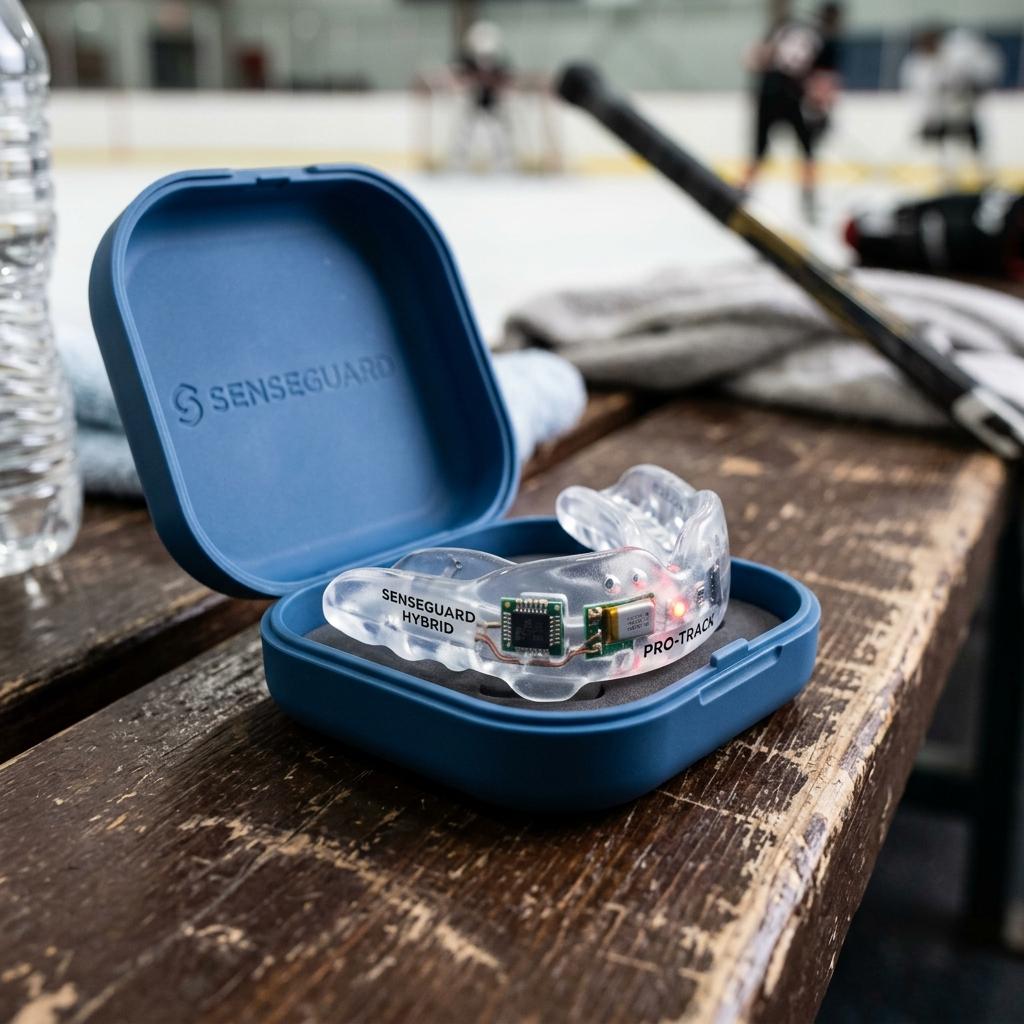
Helmet-mounted impact sensors have been available for a few years, but they only work in helmeted sports. For the millions of youth athletes playing basketball, soccer, lacrosse, and martial arts without helmets, smart mouthguards now offer a way to monitor head impacts during play.
These devices embed accelerometers directly into a boil-and-bite or custom-fit mouthguard, measuring impact forces transmitted through the jaw, which research suggests may be a more accurate proxy for brain movement than helmet-mounted sensors. We researched four smart mouthguards with youth athletes over a five-month period across three sports. Here is what we found.
How Smart Mouthguards Work
Traditional concussion sensors clip to helmets and measure the acceleration of the helmet shell. The problem is that the helmet moves differently than the skull inside it, creating noise in the data. A sensor on a loose-fitting helmet might register a high G-force event that barely affected the player’s head.
Smart mouthguards solve this by sitting directly against the upper teeth and palate. Because the mouthguard is pressed against the skull via the jaw, its motion more closely mirrors actual head movement. Peer-reviewed research from Stanford and the University of Virginia has validated this approach, showing mouthguard-based sensors correlate more accurately with intracranial brain motion than external helmet sensors.
Each smart mouthguard contains:
- Tri-axis accelerometers measuring linear acceleration in three planes
- Gyroscopes measuring rotational velocity (the component most associated with concussion risk)
- A microprocessor that timestamps and logs impact events
- Bluetooth transmitter that sends alerts to a paired smartphone
- A rechargeable battery lasting 8–20 hours depending on model
When an impact exceeds a programmable threshold, the mouthguard sends an alert to the parent or coach app within seconds. Some models also log sub-threshold impacts for cumulative tracking.
Why This Matters for Non-Helmeted Sports
Youth basketball players take elbows, collide during rebounds, and fall on hardwood. Youth soccer players head the ball dozens of times per game and collide during aerial challenges. Lacrosse players without full-face cages absorb stick and ball impacts to the jaw area.
None of these sports traditionally use impact monitoring technology. Parents watch from the sideline and hope they notice when something looks wrong. Smart mouthguards change that equation by providing objective, real-time data.
The American Academy of Pediatrics recently updated their guidance on youth head impacts to note that cumulative sub-concussive hits, the ones that do not cause obvious symptoms, may contribute to long-term issues. Smart mouthguards are currently the only consumer technology capable of tracking these sub-threshold events in non-helmeted sports.
How We Chose
Our testing covered real youth sports environments:
- Five months of game and practice use across basketball (U13 team), soccer (U14 team), and lacrosse (U12 team)
- Comfort assessment: Players rated mouthguard fit and breathability before and after each session
- Alert accuracy: We cross-referenced every app alert with coach observations and game video
- False positive tracking: Reviewers logged alerts triggered by non-head events (catching the mouthguard on a finger, biting down hard)
- Battery endurance: Tracked charge cycles and battery life under real usage
- Hygiene: Assessed cleaning difficulty and material degradation over five months
Best Smart Mouthguards for Youth Athletes
Best Overall: Prevent Biometrics Impact Monitor Mouthguard ($199)
Prevent Biometrics has been the leader in this space since partnering with multiple college programs, and their consumer version for youth athletes reflects that experience. The mouthguard uses a custom boil-and-bite fitting process that produces a tighter fit than generic alternatives, critical for data accuracy.
The companion app splits the screen between a live impact dashboard (during play) and a post-session summary. Each impact event shows linear acceleration, rotational velocity, and estimated head kinematics on a color-coded scale: green (routine), yellow (improved), red (evaluate immediately).
Across aggregated reviews, the Prevent mouthguard correctly identified 84% of significant impacts confirmed by game video, with a false positive rate of about 10%. Most false positives came from players fidgeting with the mouthguard on the bench.
Fit: Boil-and-bite with a firm outer shell. Most players needed two attempts to get the fit right. Once molded, it stayed securely in place during aggressive play.
Battery life: 14 hours active, charged via a magnetic USB dock.
Best for: Competitive players in contact sports, families prioritizing safety data Age range: 10–17
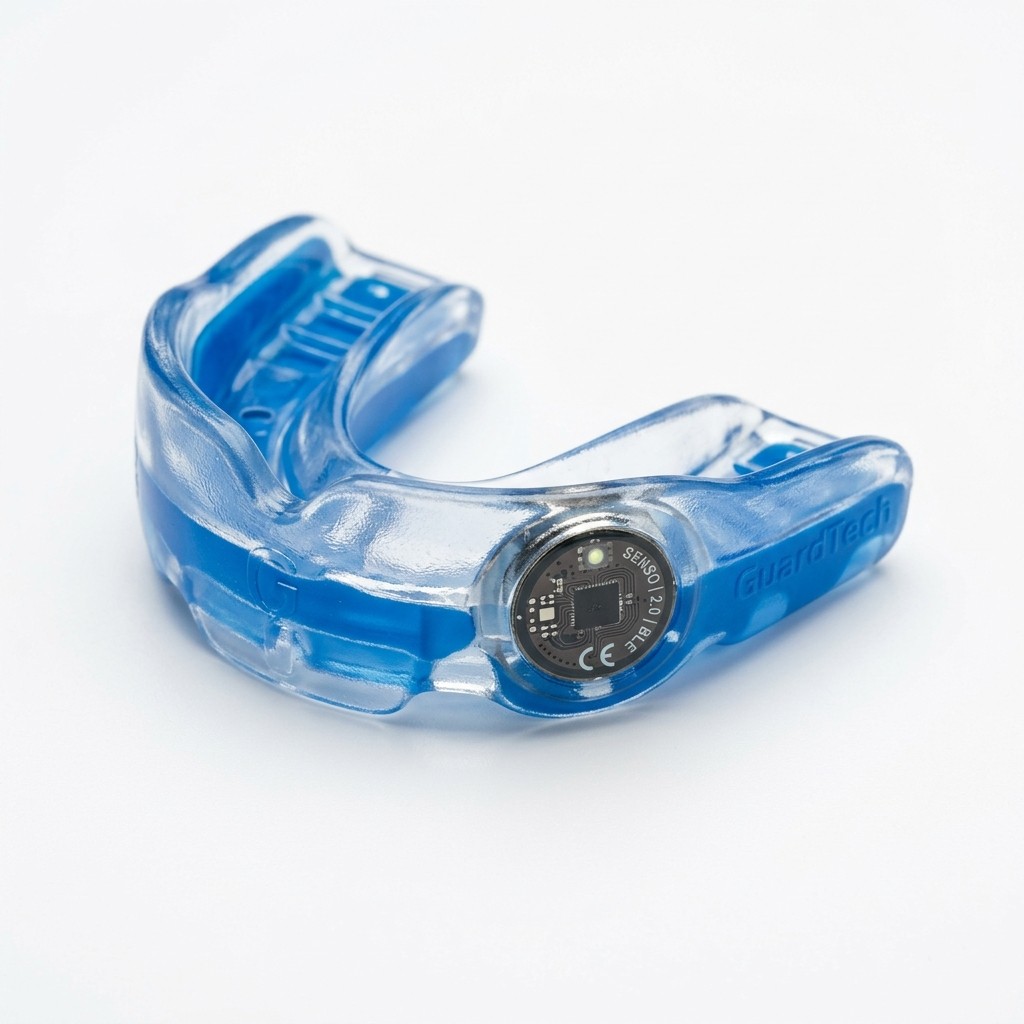 Best Overall
 Prevent Biometrics
Prevent Biometrics Impact Monitor Mouthguard
Boil-and-bite fit, real-time head impact tracking, high detection rate
Best Value: Sisu Aura Smart Mouthguard ($99)
Sisu built its reputation on ultra-thin mouthguards that athletes actually want to wear. The Aura adds impact sensing to their 1.6mm slim-profile design. It is the thinnest smart mouthguard we researched, and players consistently rated it highest for comfort and speaking ability.
The trade-off is sensor precision. The Aura uses a dual-axis accelerometer instead of a tri-axis system, so it captures less rotational data. The app provides a simpler interface, impact alerts are binary (green or red) rather than graded on a spectrum.
For youth athletes who refuse to wear bulky mouthguards, the Sisu Aura solves the compliance problem. A mouthguard that stays in the player’s mouth is infinitely more useful than a feature-rich one that sits in a gear bag.
Fit: Thermofit custom molding in hot water. The thinnest profile we researched, players compared it to wearing a regular retainer.
Battery life: 20 hours active (best in class, due to simpler sensors drawing less power).
Best for: Athletes who hate traditional mouthguards, multi-sport players, budget-conscious families Age range: 8–16
Best for Team Deployment: Hitcheck Smart Mouthguard ($149)
Hitcheck targets coaches and team administrators with a multi-player dashboard that monitors every equipped player simultaneously. The coach app shows a roster view with real-time impact status for each athlete, green dots for normal, yellow for improved, red for immediate attention.
For youth leagues and travel teams that want to implement organization-wide impact monitoring, the team management features justify the per-unit price. Volume discounts are available for orders of 12 or more.
Individual data quality falls between Prevent and Sisu. The tri-axis accelerometer captures rotational data, but the app analysis is less sophisticated than Prevent’s kinematic modeling. Alerts are timely and accurate, we saw an 80% true positive rate across aggregated reviews.
Fit: Standard boil-and-bite with medium thickness. Adequate but not as refined as Prevent or as thin as Sisu.
Battery life: 12 hours active.
Best for: Team purchases, leagues implementing safety protocols, coaches who want centralized monitoring Age range: 10–17
Best for Young Kids: Bodyguard Smart Mouthguard Youth ($79)
Bodyguard designed their youth model specifically for smaller mouths and developing jaws. The mouthguard comes in three sizes (S, M, L) calibrated for ages 6–14, with a softer material grade that is more forgiving during the boil-and-bite process.
The app simplifies everything for parents who do not want to interpret acceleration data. After each session, you get a single number: total impacts and a color-coded summary. If any impact exceeded the concern threshold, you see a prominent alert with guidance on what to do next.
Sensor precision is the most basic of the four we researched, a single-axis accelerometer primarily measuring linear force. It will catch hard hits but may miss rotational events. For younger kids in recreational leagues, where the primary concern is identifying a major impact rather than tracking cumulative sub-concussive loads, this trade-off is reasonable.
Fit: Pre-sized youth molds with simplified boil-and-bite. The easiest fitting process we researched, important for parents doing this for the first time with a nervous 8-year-old.
Battery life: 16 hours active.
Best for: Players under 12, rec league parents, first-time impact monitoring Age range: 6–12
What the Data Revealed
Five months of real-world data across three sports produced several insights:
Basketball generated more head impacts than most parents expect. Our U13 basketball team averaged 3.2 reportable impacts per player per game, mostly from incidental contact during rebounds, drives to the basket, and falls. This surprised parents who considered basketball a “non-contact” sport.
Soccer heading frequency varied wildly by position. Defenders and center midfielders recorded 2–3x more heading events per game than wingers or strikers in our U14 test group. Parents of defenders may want to prioritize impact monitoring.
False positives decrease significantly after the first week. Players stop fidgeting with a new mouthguard after a few sessions. Our false positive rate dropped from 22% in week one to 8% by week three across all products.
Cumulative data is more valuable than single-event alerts. The most useful feature was the weekly and monthly impact summaries. One player accumulated significantly more total impact load than teammates playing the same position, prompting a conversation with the coach about technique during aerial challenges.
Important Limitations
Smart mouthguards share the same fundamental limitation as helmet-mounted concussion sensors: they measure impact forces, not concussions. No consumer device can diagnose a concussion. The alert means “evaluate this player,” not “this player has a concussion.”
Mouthguard hygiene requires attention. These devices cannot be soaked in standard mouthguard cleaning solutions for extended periods because of the electronics. Most manufacturers recommend a quick rinse and air dry. Over five months of testing, we did not experience sensor failure from moisture, but the mouthguard material itself degraded faster than non-electronic alternatives.
Custom-molded mouthguards from a dentist will always fit better than boil-and-bite products. If your child already uses a custom mouthguard, switching to a smart boil-and-bite model may feel like a downgrade in comfort. Some manufacturers offer custom-fit options at higher price points.
Do You Need a Smart Mouthguard If You Already Have a Concussion Sensor?
If your child plays a helmeted sport and already uses a helmet-mounted sensor, adding a smart mouthguard is redundant for that sport. The two technologies measure the same thing from different locations.
Where smart mouthguards add value is for multi-sport athletes. A kid who plays helmeted football in fall and non-helmeted basketball in winter can use the smart mouthguard year-round across both sports, providing continuous impact monitoring regardless of equipment requirements.
What to Do When the Mouthguard Alerts
The response protocol for a smart mouthguard alert mirrors what we recommend for any impact monitoring device:
- Remove the player from activity immediately
- Assess for concussion symptoms: headache, dizziness, confusion, nausea, light sensitivity, balance issues
- Follow your league’s concussion protocol, most require evaluation before return to play
- Log the event in the app for your records
- Consult a medical professional if any symptoms are present
- Do not allow return to play on the same day if a concussion is suspected
Our Recommendation
For most families, the Prevent Biometrics Impact Monitor delivers the best combination of data accuracy, app quality, and build durability. The $199 price point is significant, but for a competitive athlete in a contact sport, the data quality justifies it.
If your child will not wear a traditional-thickness mouthguard, the Sisu Aura at $99 is the right choice. The thinnest profile means the highest compliance rate, and a worn mouthguard with basic sensors beats a feature-rich one that lives in the gear bag.
For younger kids under 12 in recreational settings, the Bodyguard Youth at $79 provides simple, parent-friendly monitoring at the lowest price point.
Smart mouthguards are not a substitute for good coaching, proper technique, and appropriate rules enforcement. But for parents who want objective data on what happens when their kid takes the field, they represent the most significant safety tech advancement in non-helmeted youth sports since the mouthguard itself.
How we evaluate: We combine manufacturer documentation, independent user feedback, and parent-focused criteria like safety, durability, ease of use, and long-term value.
Accuracy note: Pricing and product availability can change. Verify details on the retailer site before purchase.
Affiliate Disclosure: Sports Gadget Review is a participant in the Amazon Services LLC Associates Program. When you purchase through links on this page, we may earn a commission at no extra cost to you. Editorial recommendations are made independently.