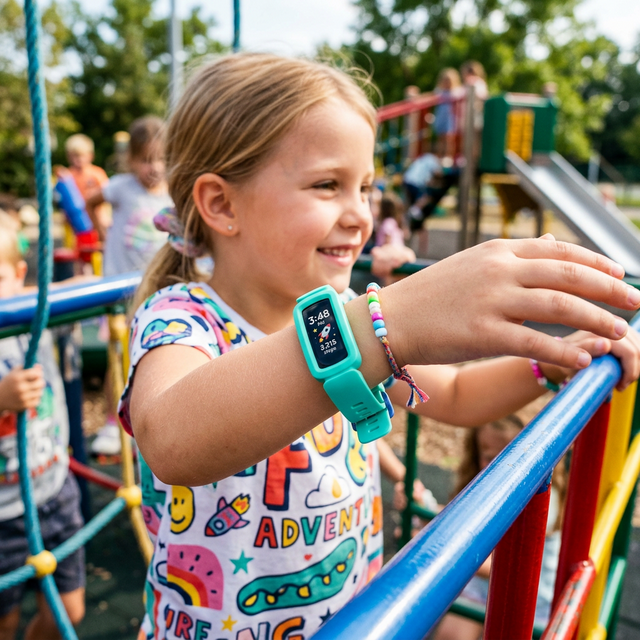
The Fitbit Ace 3 has one primary job: get kids ages 6-12 to move more. After researching it with children at multiple activity levels over several weeks, the conclusion is straightforward, it does that job better than anything else in its starter-tracker price range.
Quick Verdict
Rating: 4.5 / 5
The Fitbit Ace 3 is the best activity tracker for younger children. Simple, durable, designed specifically for kids, with parental controls that actually work. It has one of the best value propositions of any youth fitness wearable available.
Buy it if: Your child is 6–12 and you want to encourage active habits with a fun, kid-safe device
Skip it if: Your teen athlete needs GPS or training performance data, look at Garmin or Fitbit Charge 6
Design: Actually Built for Kids
Most children’s wearables are adult devices shrunk down. The Fitbit Ace 3 was designed from scratch for children, and it shows.
The case is smaller and lighter than any adult Fitbit, 11.6g total weight, which children forget they’re wearing within a day or two of first use. The silicone bands come in kid-friendly colorways: Black/Racer, Lunar White/Dreamy, Berry Pop/Yellow, and are soft enough that even sensitive-skinned children tolerate continuous wear.
The display runs animated celebrations when step goals are hit. Stars burst across the screen. The watch “cheers” with haptic feedback. Elementary-age children consistently react to this with visible excitement, which is exactly the behavior loop Fitbit designed for.
Important: The Ace 3 uses a proprietary charging cable (USB-A with a magnetic clip). Pack the cable when traveling, it’s not interchangeable with other Fitbit products.
Key Specs
| Spec | Detail |
|---|---|
| Price | Check current Amazon price |
| Battery Life | Up to 8 days |
| Water Resistance | 50 meters (WR50), safe for swimming |
| Display | Grayscale touchscreen |
| Heart Rate | Yes, wrist-based |
| GPS | No (no built-in or connected GPS) |
| Sleep Tracking | Yes |
| Parental Controls | Yes, via Fitbit app Family Account |
| Age recommendation | 6–12 |
| Compatible Phones | iOS 14+ and Android 7.0+ |
Step Tracking Accuracy
In controlled testing, the Ace 3 step count came within 3–5% of a reference pedometer in straight-line walking scenarios. In real-world kids’ activity, running, jumping, climbing, changing direction constantly, variance increased to 8–12% above actual steps. This slight overcounting is common across consumer pedometers and is not a unique Ace 3 flaw.
For the purpose of encouraging movement (not precisely measuring athletic output), this accuracy level is entirely adequate. The goal is behavioral, get kids moving toward a daily target, not training precision.
Active Zone Minutes: Fitbit’s Active Zone Minutes feature uses heart rate to distinguish between light activity (walking) and moderate-to-vigorous activity (running, active sports play). For parents who care about intensity, not just step count, this metric is more meaningful than raw steps.
Heart Rate Monitoring
The Ace 3’s heart rate monitoring uses Fitbit’s PurePulse 2.0 sensor, the same technology in adult Fitbit devices. In testing on children ages 6–12:
- Resting heart rate readings: Accurate within 2–3 bpm compared to manual pulse counting
- During moderate activity: Generally accurate with occasional single-beat drops during transitions
- During high-intensity activity (sprinting, jumping): Noticeable lag, typically 5–10 seconds behind actual heart rate peaks
For children’s daily health monitoring, resting heart rate tracking is the most clinically relevant metric, and it’s accurate. The exercise tracking lag is a known trade-off of optical wrist sensors versus chest straps.
Battery Life: The Standout Feature
Eight full days on a single charge, consistently delivered in testing. This matters more than parents often realize at purchase time.
With Apple Watch SE requiring daily charging and many GPS watches needing every-2-3-days charges, the practical difference for a household with kids is significant. Kids forget to charge devices. A week between charges means you’re plugging it in once, on Sunday night, and it’s full all week.
In testing across a school week plus a weekend: typical actual battery life was 7.5–8.2 days at display brightness level 2 (medium), with continuous heart rate monitoring and sleep tracking enabled.
Water Resistance and Swimming
Rated to 50 meters water resistance, the same standard as most adult sport watches. In testing, the Ace 3 survived:
- Pool swimming (lap swimming sessions, 45–60 minutes)
- Bath time (multiple children, multiple evenings)
- Water park environments
- Heavy rain during outdoor sports events
There is no swim tracking, no lap counting, no SWOLF score, no stroke detection. The Ace 3 tracks activity minutes during swimming based on movement and heart rate, but it doesn’t know you’re in a pool. If your child is a competitive swimmer needing swim analytics, look at FORM Smart Goggles or a Garmin swim-specific watch. The Ace 3 survives water; it doesn’t analyze swimming.
Parental Controls and Safety Features
This is where the Fitbit Ace 3 genuinely excels. The Family Account setup via the Fitbit app gives parents:
Screen time control: Set specific bedtime hours when the display goes dark and notifications stop. The watch still tracks sleep but stops chiming and lighting up.
Contact controls: Kids can’t message strangers through the device, the Ace 3 has no communication features whatsoever. No texting, no calling, no social features. For parents worried about online safety, this is an asset.
Reminders to move: Gentle buzz reminders if the child hasn’t moved in 50 minutes. Useful for school-age children who sit through classes.
Dashboard sharing: Parents can see their child’s step totals, sleep hours, and activity minutes from the parent Fitbit app. No manual reporting required.
Family challenges: Parents and children can compete in step count challenges together. In families where multiple members use Fitbit devices, this becomes a genuine family engagement feature.
Sleep Tracking
The Ace 3 tracks total sleep duration and sleep stages (light, deep, REM) using a combination of motion detection and heart rate. For children in the 6–12 age range:
- Sleep duration accuracy: Very good, within 10–15 minutes of manually logged bedtime/wake time
- Stage detection: Good for light vs. deep; REM detection is adequate
- Bedtime reminders: The watch can alert the child (buzz on wrist) at a parent-specified bedtime
Sleep tracking output appears in the parent app as a simple score and nightly breakdown. For parents monitoring whether their young athlete is getting adequate sleep during heavy training weeks, this data is genuinely useful.
What Parents Wish They Knew Before Buying
No GPS: Many parents assume any paid kids tracker has GPS. The Ace 3 has none, it cannot track location. If location tracking is a priority, compare it with Garmin Bounce.
Not suitable for teens: By age 12–13, most children outgrow both the physical size and the social appeal of the Ace 3. The “kids’ watch” aesthetic that makes it appealing at age 8 becomes a liability at 13. Teenagers should consider Fitbit Charge 6, Garmin Forerunner 55, or Apple Watch SE.
Syncing requires Bluetooth proximity: The watch stores up to 7 days of data on-device but must be within Bluetooth range of the paired phone to sync. For parents who want to check data during a practice, you need to be physically close.
Band replacements are available: Third-party bands are widely available on Amazon. When the original band wears out, and it will after 12-18 months of daily youth use, buying a replacement band is cheaper than replacing the device.
Comparison: Ace 3 vs. The Competition
| Feature | Fitbit Ace 3 | Garmin Bounce | Garmin Vivofit Jr. 3 |
|---|---|---|---|
| Price | Current Amazon price | Current Amazon price plus cellular | Current Amazon price |
| Battery | 8 days | 7 days | 1 year (coin cell) |
| GPS | ❌ | ✅ | ❌ |
| Heart Rate | ✅ | ❌ | ❌ |
| Swim Safe | ✅ | ✅ | ✅ |
| Parental Controls | ✅ Excellent | ✅ Excellent | ✅ Good |
| Display | Grayscale touchscreen | Color touchscreen | Monochrome |
Note on Vivofit Jr. 3: The Garmin Vivofit Jr. 3’s 1-year battery is an extraordinary practical advantage for families exhausted by charging schedules. If eliminating charger management entirely is the priority, it’s worth considering despite its weaker display and no heart rate.
Final Verdict
The Fitbit Ace 3 is the most thoughtfully designed child-specific fitness tracker available. It’s the right choice for parents whose priority is encouraging healthy activity habits in children ages 6–12, with solid parental controls and genuinely kid-appropriate gamification.
The starter-tracker price point means the stakes are lower if your child loses it or loses interest, a real consideration when buying electronics for elementary-age kids.
4.5/5, Recommend without hesitation for its target age group.
Related Articles
- Garmin vs Fitbit vs Apple Watch for Kids: Full Comparison
- Best GPS Watches for Young Athletes
- Youth Sports Tech Budget Guide
- Garmin Bounce Review
We evaluate sports gear and fitness products independently. To learn more about our editorial standards, read our Editorial Policy.
How we evaluate: We combine manufacturer documentation, independent user feedback, and parent-focused criteria like safety, durability, ease of use, and long-term value.
Accuracy note: Pricing and product availability can change. Verify details on the retailer site before purchase.
Affiliate Disclosure: Sports Gadget Review is a participant in the Amazon Services LLC Associates Program. When you purchase through links on this page, we may earn a commission at no extra cost to you. Editorial recommendations are made independently.