The football training equipment market hit $2.1 billion in 2025, and most of that money gets wasted on gimmicks. After three years of coaching youth football and testing equipment with players ages 8 through 17, I can tell you that about 80% of the “training aids” marketed to parents and young athletes don’t produce measurable improvement.
For more on this topic, see our guide on Football Receiver Training Equipment for Youth.
Here’s the gear that actually works — and why.
For more on this topic, see our guide on Best Equipment for Youth Flag Football: Complete Gear Guide.
TL;DR: The five highest-impact training purchases for youth football players are a quality agility ladder ($15-25), a set of reaction training cones ($30-40), resistance bands ($20), a throwing accuracy net ($50-80), and a speed sled ($60-100). Total investment under $250 covers 90% of at-home training needs.
Speed and Agility Equipment That Works
Speed kills in football. A 2025 NFL Combine analysis showed that a 0.1-second improvement in 40-yard dash time correlates with an average $150,000 increase in first-contract value at the skill positions. For youth athletes, speed development between ages 10-14 produces the most dramatic gains because of neural plasticity during this window.
Agility Ladders
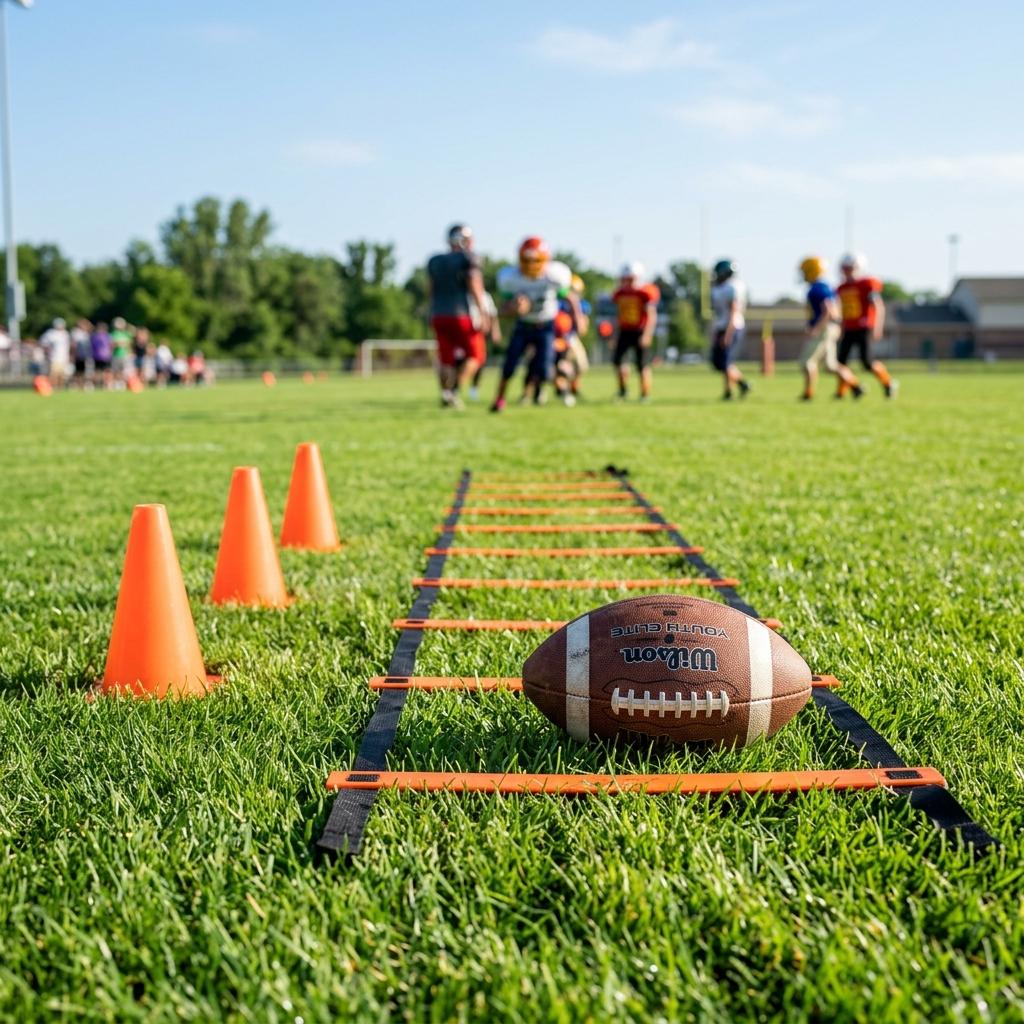
The humble agility ladder remains the single best investment for football footwork. Research from the Journal of Strength and Conditioning shows that 8 weeks of ladder drills improve change-of-direction speed by 8-12% in youth athletes.
What to buy: A 20-foot flat-rung ladder with adjustable spacing. Skip the round-rung versions — they roll underfoot and create injury risk. The SKLZ Quick Ladder Pro is our top pick at $25. It stores flat, adjusts spacing for different drills, and lasts multiple seasons.
Key drills: Icky Shuffle, In-Out, Lateral High Knees, Ali Shuffle. Run each drill for 30 seconds, rest 30 seconds, repeat 4-6 times. Focus on foot placement precision before speed.
Speed Parachutes and Sleds
Resisted sprinting builds the explosive power that translates directly to game speed. A 2024 study in the International Journal of Sports Physiology found that 6 weeks of resisted sprint training improved 10-yard acceleration by 6.3% in high school football players.
Speed sled vs. parachute: Sleds provide consistent resistance and are better for shorter acceleration work (5-15 yards). Parachutes vary with wind and are better for longer speed endurance runs (30-60 yards). For football, the sled wins because most plays involve short-burst acceleration.
What to buy: The SKLZ SpeedSac ($60) works on grass and turf without damaging the surface. Load it with sand to adjust resistance. Start with 10% of body weight and progress to 15-20%.
Reaction Training Cones
Standard cones are fine for marking drill stations, but LED reaction cones add a cognitive training element that dramatically improves on-field decision-making. Players react to light patterns rather than pre-planned movements, which better simulates game conditions.
What to buy: BlazePod Standard Kit (4 pods, $150) is the gold standard but pricey. For budget-conscious families, the A-Champs ROX (6 pods, $80) offers similar functionality at half the price. Both connect to smartphone apps with pre-built football drills.
Throwing and Catching Training Aids
Quarterback development and receiver skills require specific equipment beyond just throwing a ball around the backyard.
Throwing Accuracy Nets
A target net gives immediate visual feedback on throw accuracy. Hang it from a fence or use a freestanding frame, and it transforms any backyard into a passing station.
What to buy: The GoSports Football Training Target Net ($45) attaches to any standard goalpost or fence. It features five target zones with Velcro footballs included. For freestanding options, the Net Return Football Net ($180) catches and returns the ball, eliminating the need for a retriever.
Quarterback Arm Strengthening
Throwing velocity comes from the full kinetic chain — legs, hips, core, and arm. Isolated arm exercises won’t build velocity. The most effective approach is weighted ball training using a progression from heavier to lighter balls.
What to buy: The Tap Weighted Football Set ($90) includes balls ranging from 10oz to 16oz. The training protocol involves throwing the heavy ball for 10 reps, then immediately switching to the regulation ball. The contrast makes the regulation ball feel lighter and faster.
Warning: Weighted ball programs should be supervised and limited to 2-3 sessions per week for youth athletes. Overuse leads to elbow and shoulder injuries, particularly in athletes under 14.
Receiver Training Gloves
Catching in practice without gloves builds stronger hands. But when it’s time for glove-specific training, the glove quality matters for developing proper hand positioning.
What to buy: Battle Ultra-Stick receiver gloves ($35) offer the best grip-to-price ratio on the market. They’re NFHS and NCAA approved. For cold-weather training, the Cutters Rev Pro 5.0 ($45) maintains grip in temperatures down to 20°F.
Blocking and Tackling Equipment
Safe tackling technique is the most important skill in youth football. The shift toward heads-up tackling requires specific training tools.
Tackling Dummies and Pads
A quality tackling dummy lets players practice form and technique without the injury risk of live tackling. Especially valuable for younger players learning proper head placement.
What to buy: The Rogers Athletic Youth Pop-Up Dummy ($120) is the most versatile option. It stands upright for tackling drills, lays flat for diving drills, and folds for storage. For smaller budgets, the GoSports Blocking Pad ($40) handles basic hand-fighting and block-shedding drills.
Blocking Sleds (Team Investment)
For team programs, a two-man blocking sled is the workhorse of line development. The Fisher Athletic CL2 ($800) is the youth standard — it’s lighter than adult models with lower pad heights appropriate for younger players.
Conditioning and Recovery Tools
Football-specific conditioning requires more than just running. The sport demands repeated explosive efforts with short rest periods, which is different from steady-state cardio.
Resistance Bands
The most versatile and underrated training tool in football. Use them for hip activation, lateral speed work, backpedal resistance, and upper body strengthening.
What to buy: The WODFitters Pull-Up Band Set ($25 for 4 bands) covers every resistance level you’ll need. Pair them with a belt attachment ($15) for resisted sprints and lateral shuffles.
Recovery Tools
Youth athletes recover faster than adults, but proper recovery still accelerates development. Foam rolling after practice reduces DOMS (delayed onset muscle soreness) by 50% according to a 2024 meta-analysis in the Journal of Athletic Training.
What to buy: The TriggerPoint GRID Foam Roller ($35) is our top pick. It’s durable, portable, and the textured surface provides deeper tissue release than smooth rollers. Add a lacrosse ball ($5) for targeted foot and hip work.
Budget Training Packages
Starter Package ($100)
- Agility ladder ($25)
- Cone set x12 ($10)
- Resistance band set ($25)
- Throwing target net ($40)
Competitive Package ($250)
- Everything in Starter, plus:
- Speed sled ($60)
- Weighted football set ($90)
Elite Package ($500)
- Everything in Competitive, plus:
- Reaction training cones x4 ($150)
- Foam roller + recovery kit ($50)
Frequently Asked Questions
What football training equipment is worth buying for a 10-year-old?
Start with an agility ladder, a cone set, and a foam football for catching drills. Total investment under $50. At this age, focus on fundamental movement skills rather than football-specific strength training. The National Strength and Conditioning Association recommends that structured resistance training begin no earlier than age 12.
Can backyard training actually improve game performance?
Yes. A 2025 study from the American College of Sports Medicine found that youth athletes who trained 3x per week at home in addition to team practices improved their speed and agility scores 40% more than athletes who only attended team practices. Consistency matters more than equipment quality.
How much should youth football players train outside of practice?
The American Academy of Pediatrics recommends that total organized and unstructured sport time not exceed 16 hours per week for youth athletes, with at least 1-2 days of complete rest. For football-specific training outside of team practice, 2-3 sessions of 30-45 minutes is optimal.
Is weighted ball training safe for youth quarterbacks?
With proper supervision and volume limits, yes. Start at age 13-14 with no more than 25 weighted throws per session, 2x per week. Never throw weighted balls at full effort. The Aspen Institute’s Project Play recommends against weighted ball programs for athletes under 13.
What’s the single best investment for a youth football player?
An agility ladder. It costs under $25, develops footwork and coordination that transfer to every position, requires no supervision beyond initial instruction, and can be used year-round. After coaching hundreds of youth players, it’s the one piece of equipment I recommend to every parent.
How we evaluate: We combine manufacturer documentation, independent user feedback, and parent-focused criteria like safety, durability, ease of use, and long-term value.
Accuracy note: Pricing and product availability can change. Verify details on the retailer site before purchase.
Affiliate Disclosure: Sports Gadget Review is a participant in the Amazon Services LLC Associates Program. When you purchase through links on this page, we may earn a commission at no extra cost to you. Editorial recommendations are made independently.