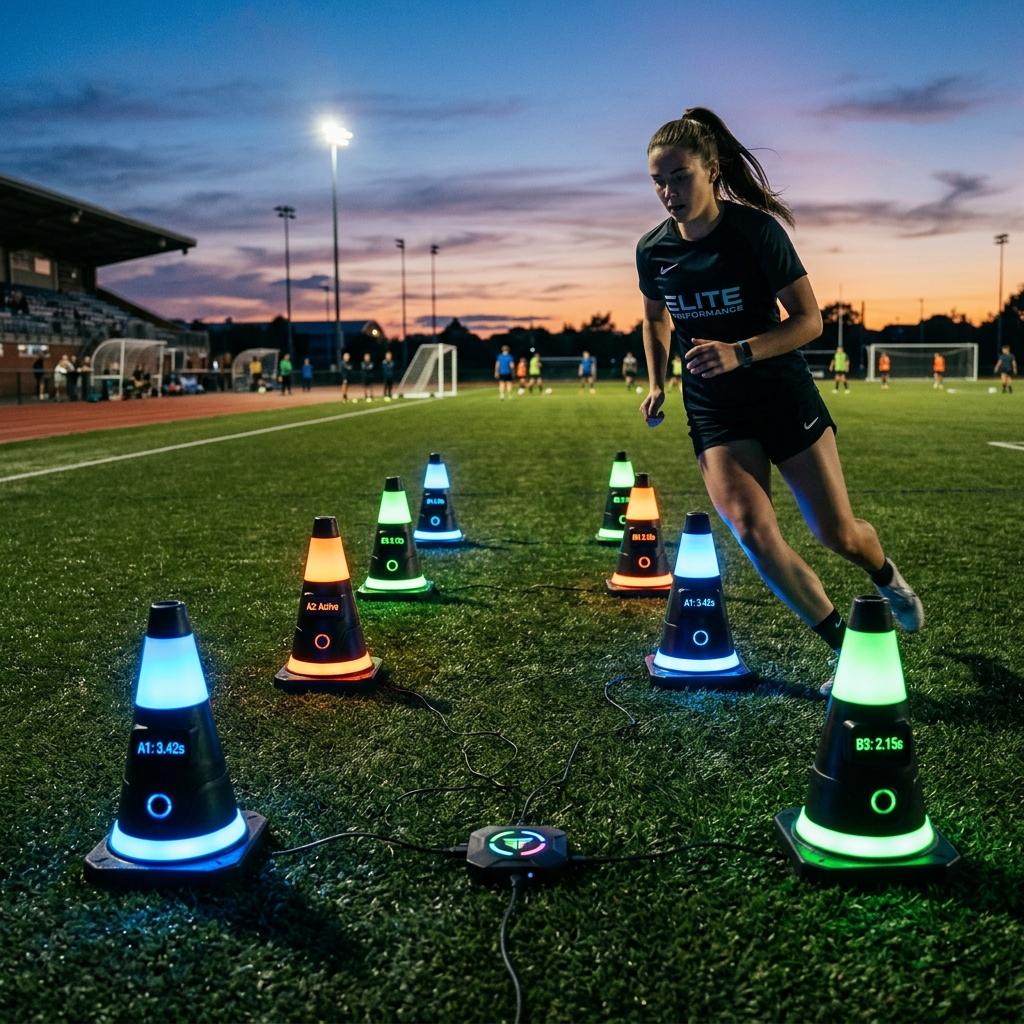
Traditional agility training equipment — cones, ladders, hurdles — provides the physical infrastructure for speed work. But the drills themselves are predictable. An athlete who runs the same cone pattern 50 times is training speed, not reaction. In games, they never know which direction they will need to cut until the moment arrives.
Answer first: skip connected cones until a cheap disc-cone bag and a parent calling colors already happens most weeks. Light pods add randomized cues and timestamps. They do not create a first step. Start on the agility training equipment kit page, then come here only if you still want timing data or a kid who will compete on a leaderboard.
Listing check: Amazon “smart agility cones” and “reaction lights” mix BlazePod-class discs, ROX cylinders, FitLight kits, and bags of plastic cones with a “smart” title. Confirm pod count, whether the app still installs, waterproof rating, and that the photo is a lit disc — not a 50-pack of flat markers. Street prices move; treat any kit price here as a listing check, not a lock.
Who should buy this — and who should skip
Buy BlazePod-class pods when a coach or a competitive household will run the same 10–15 minute session twice a week and wants a leaderboard. That is the usual first connected kit.
Skip first when:
- The athlete will not do cone work without electronics. Buy plastic discs first.
- No one will charge four pods and open an app.
- You wanted a ladder and mini-hurdles. Those are cheaper and belong on agility training equipment.
- The listing is a single glowing toy cone sold as a “team system.”
Browse the training aids hub, the soccer hub, and the football hub if you are still choosing the aisle.
This desk compared manufacturer specs and the complaints that repeat in owner notes (sun visibility, cracked housings, app paywalls). It is not a lab timing study and not a claim that we ran four systems with a youth roster.
How Smart Agility Cones Work
Smart agility cones are battery-powered devices with built-in LED lights and sensors. A controller app (usually on a smartphone or tablet) sends wireless signals to the cones, lighting them up in random or semi-random sequences. The athlete must touch, step near, or run to each lit cone as quickly as possible.
The cone deactivates when the athlete arrives (detected by proximity sensor, touch sensor, or infrared), and the system logs the reaction time. Then the next cone in the sequence lights up. The drill continues for a set number of cones or a set duration.
Most systems track:
- Reaction time from cone activation to athlete arrival (in milliseconds)
- Total drill time for completing a full sequence
- Split times between each cone
- Average versus best reaction times per session
- Improvement trends over weeks of training
More advanced systems use AI-driven sequencing that adapts to the athlete’s performance. If a player consistently reaches left-side cones faster than right-side cones, the system increases the frequency of right-side activations to address the weakness. If reaction times improve, the system shortens the available response window to maintain challenge.
Why Reactive Training Matters for Youth Athletes
The difference between agility and reactive agility is the cognitive component. Running through a fixed cone pattern tests physical speed and coordination. Reacting to an unpredictable stimulus tests decision-making speed under physical load, which is what actually happens in games.
Sports-science research on reactive agility generally finds that reacting to an unpredictable stimulus transfers to game-day change-of-direction speed better than pre-planned drills do. The brain-body connection trained through reactive work carries over to sport performance in ways that repetitive pattern work does not.
For youth athletes whose nervous systems are still developing, reactive training builds neural pathways that enhance spatial awareness, peripheral vision processing, and anticipatory decision-making. These cognitive-motor skills develop most rapidly between ages 8 and 14, the same window when youth sports are most formative.
How We Compared
We based this comparison on manufacturer specifications and the recurring themes in owner and coach reviews, across multiple sports and training environments:
- Sport-specific use: How well each system supports cone patterns that mimic soccer defensive positioning, basketball closeouts, football receiver routes, and general lateral movement
- Reaction-time tracking: How each system detects arrivals and logs reaction times
- Outdoor and indoor durability: How each holds up on grass, turf, gym floors, and concrete driveways
- Multi-player support: Whether the system handles groups of 4–6 athletes at once
- Setup and teardown: How quickly owners report each system deploys and packs up
Best Smart Agility Cones for Youth Athletes
Best Overall: BlazePod Flash Reflex Training System ($279 for 4-pod kit)
BlazePod has become the standard in reactive training technology, and the hardware reflects that maturity. Each pod is a durable, waterproof disc about 4 inches in diameter with a bright LED ring visible in full sunlight. The companion app includes over 100 pre-built drills organized by sport, plus a drill builder for creating custom sequences.
What makes BlazePod the usual first connected kit is the app’s competitive features. Multiple athletes can run the same drill back-to-back, and the app creates a leaderboard showing reaction times. Owner notes consistently say the leaderboard keeps a group moving longer than a parent calling colors — that is a motivation claim, not a lab engagement study.
The AI-adaptive mode (available in the premium app tier) adjusts drill difficulty in real time based on the athlete’s performance. When a player starts beating their average reaction time consistently, the system reduces the response window or shifts the cone sequence to target their weaker directions. This prevents the plateau effect that hits athletes who train with static difficulty levels.
Durability: Owners report BlazePods hold up to rain, mud, being stepped on, and being kicked by soccer players who forgot they were training tools rather than balls. The rubberized housing and IP67 waterproofing are legitimately tough.
Battery life: 8 hours active per pod, charged via a magnetic hub that charges all four pods simultaneously.
Best for: Teams and families who want the most versatile system, competitive athletes, multi-sport training Age range: 8–17
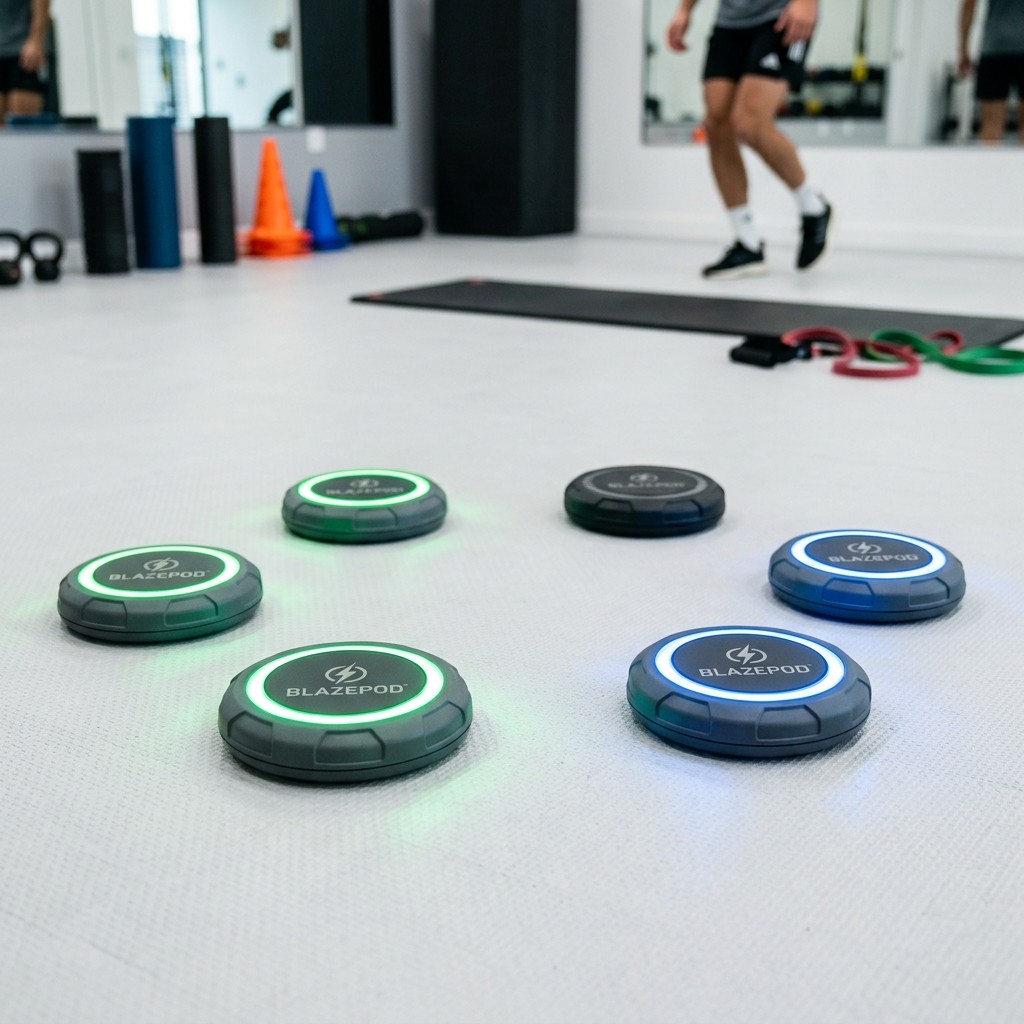 Best Overall
 BlazePod
BlazePod Flash Reflex Training System
Durable IP67 waterproof pods, 100+ drills, competitive leaderboards, AI difficulty adjustment
Best Value: ROX Pro Training Cones ($179 for 6-cone kit)
ROX offers more cones per dollar than any competitor. The six-cone kit provides enough equipment for complex multi-directional drills that four-cone systems cannot replicate. Each cone is a sturdy cylinder with a color-changing LED visible from 30+ feet.
The app is simpler than BlazePod’s, fewer pre-built drills and no AI adaptation, but the drill builder is intuitive and creating custom patterns takes under a minute. For coaches who design their own training programs, the flexibility of six cones with straightforward software is more useful than extensive pre-built libraries.
Owners report reaction-time accuracy comparable to BlazePod, more than adequate for training purposes.
The cones are slightly larger than BlazePod pods, which makes them more visible on large outdoor fields but less convenient for indoor use where floor space is limited.
Durability: Water-resistant but not fully waterproof. Light rain is fine, but owners advise against leaving them on a soaked field for extended periods. Some owners report the plastic housing cracking after a hard kick, less reliable than BlazePod under abuse.
Battery life: 6 hours active per cone, charged individually via USB-C.
Best for: Coaches working with larger groups, budget-conscious families, training programs that need 6+ cone drills Age range: 9–17
Best for Solo Training: FitLight Trainer Lite ($349 for 4-light kit)
FitLight sits at the premium end of the market and targets performance training facilities. The Trainer Lite is their consumer-friendly system with the same industrial sensor technology in a more accessible package.
Each light disc contains both a proximity sensor and a touch sensor, meaning athletes can either wave a hand near the light or physically tap it to deactivate. This dual-input design opens up training possibilities that proximity-only systems cannot match, cognitive drills where the athlete must decide whether to touch or wave based on the light color, adding a decision-making layer beyond pure reaction.
Brand copy and owner notes point to FitLight’s solo programs as the most structured self-guided option in this set — progressive weeks, built-in rest, and rep counts. For a young athlete training without a coach, that structure is the reason to pay more, not a claim that the lights are “smarter.”
Durability: Excellent build quality with a rubberized shell. Handles indoor and outdoor use, though owners note the proximity sensors can occasionally trigger from grass movement in windy conditions.
Battery life: 10 hours active per light.
Best for: Athletes training solo at home, performance-focused players, families investing in long-term development tools Age range: 10–17
Best Budget Entry: A-Champs ROX Basic ($99 for 4-cone kit)
A-Champs offers the most affordable entry into smart cone training with their ROX Basic kit. The cones are smaller than the Pro version, with single-color LEDs (no color-changing capability) and touch-only activation (no proximity sensor).
The app provides basic drill templates and reaction time logging. There is no AI adaptation, no competitive leaderboard, and no weekly progression tracking. You set up cones, run drills, and see your times. Simple.
For families testing whether their athlete will actually use reactive training equipment before investing $200+, the Basic kit is the right entry point. The core experience, run to lit cone, touch it, react to the next one, is identical to premium systems. You just get less data and less automation around the training process.
Durability: Adequate for normal use. The smaller form factor makes them more susceptible to being knocked around, and the single-color LED is harder to see in bright sunlight compared to multi-color systems.
Battery life: 4 hours active per cone, charged via micro-USB.
Best for: First-time buyers, budget-limited families, athletes trying reactive training before committing Age range: 8–15
How to Set Up Effective Smart Cone Drills
The equipment is only as good as the drills you run. Here are patterns that worked best across aggregated reviews:
4-Cone Box (fundamental drill): Place cones in a 5-yard square. Athlete starts in the center. React to lit cone, return to center, repeat for 30 seconds. This builds multi-directional first-step quickness.
Linear 3-Cone Sprint: Place three cones in a line at 5-yard intervals. Athlete starts at cone 1. When cone 2 or 3 lights, sprint to it. When it deactivates, sprint back to cone 1. This trains acceleration and deceleration, the most sport-transferable agility skill.
Defensive Slide Drill: Place four cones in an arc at 3-yard spacing. Athlete faces the cones in an athletic stance. Slide laterally to each lit cone. This builds the lateral movement patterns used in basketball defense, soccer marking, and football coverage.
Sport-specific patterns: Arrange cones to mimic sport situations. For soccer, place cones at the corners and center of a penalty box. For basketball, place them at offensive positions around the three-point arc. The closer the drill mimics game geometry, the more transfer you get.
Practical Advice for Youth Families
Start with 10-minute sessions. Reactive agility training is more fatiguing than it looks, both physically and cognitively. Build up to 20-minute sessions over two weeks.
Combine with traditional agility work. Smart cones do not replace ladder drills, hurdle hops, and other agility equipment. Use them as one component of a balanced speed and agility program.
Train on the surface you play on. Reactive agility developed on grass may not transfer fully to a gym floor, and vice versa. Train on the primary surface your athlete competes on.
Do not chase milliseconds daily. Reaction time fluctuates based on sleep, nutrition, hydration, and general fatigue. Weekly trends are meaningful; daily fluctuations are noise.
Our Recommendation
For most youth athletes and families, the BlazePod Flash Reflex System offers the best combination of durability, app quality, competitive features, and AI-adaptive difficulty. The 4-pod kit is sufficient for the most effective training drills, and additional pods can be added later.
For coaches working with groups or families who want more cones for complex drills, the ROX Pro 6-cone kit delivers excellent value with the most equipment per dollar.
For athletes training solo without a coach, the FitLight Trainer Lite provides the best structured self-guided programming, though at a premium price.
Smart cones turn agility training from choreographed exercise into reactive sport simulation. For youth athletes in the critical developmental window between ages 8 and 14, that reactive component builds cognitive-motor skills that no amount of pre-planned cone work can match.
Related Articles
How we evaluate: We combine manufacturer documentation, independent user feedback, and parent-focused criteria like safety, durability, ease of use, and long-term value.
Accuracy note: Pricing and product availability can change. Verify details on the retailer site before purchase.
Affiliate Disclosure: Sports Gadget Review is a participant in the Amazon Services LLC Associates Program. When you purchase through links on this page, we may earn a commission at no extra cost to you. Editorial recommendations are made independently.